About

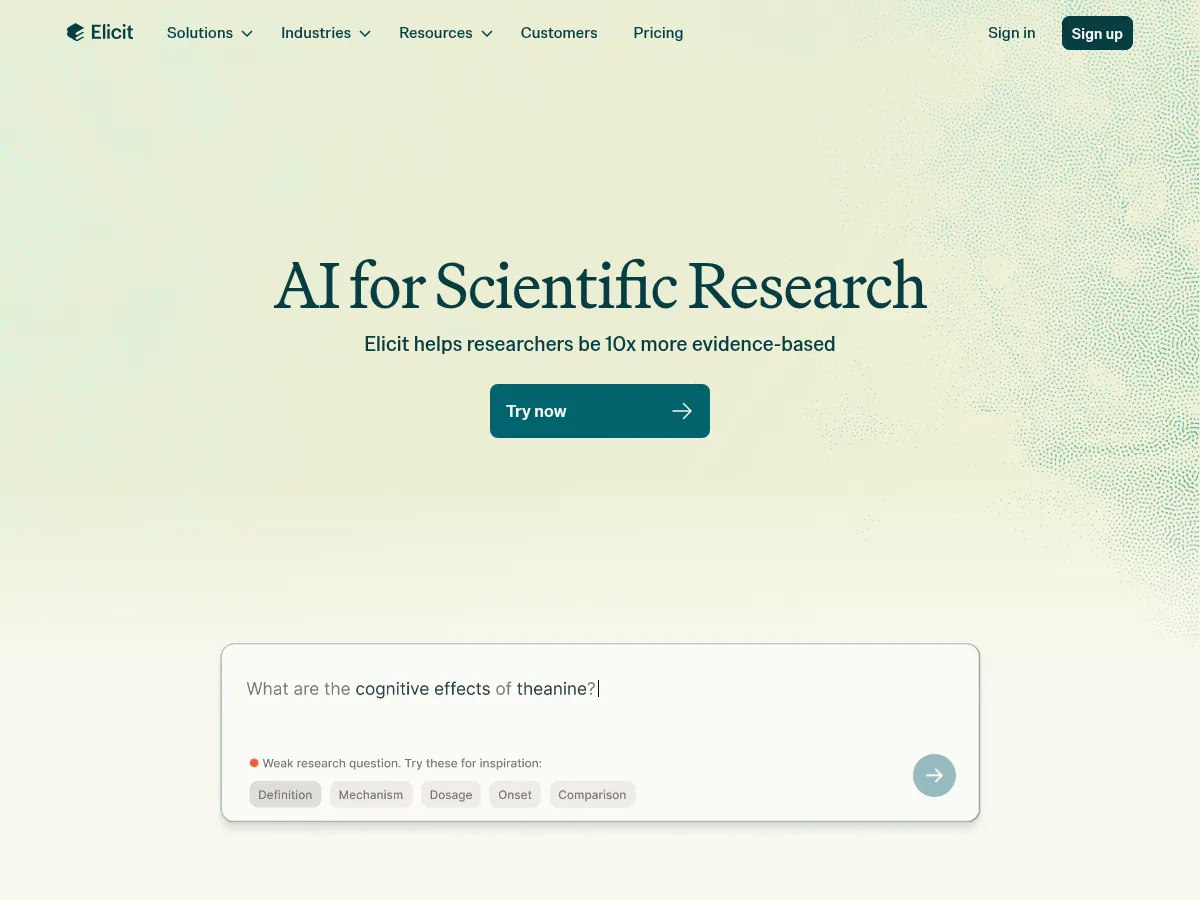
Elicit is an AI-powered research assistant designed to help researchers, academics, and professionals find, analyze, and synthesize information from academic papers and scientific literature. Developed by Ought, a nonprofit machine learning research lab focused on improving reasoning, Elicit uses large language models to automate and accelerate key parts of the research workflow. Users can ask research questions in natural language, and Elicit searches across a database of over 200 million academic papers to identify the most relevant studies, extracting key findings, methodologies, sample sizes, outcomes, and other critical details from each paper. The platform's core functionality includes semantic search that understands the meaning behind research queries rather than relying solely on keyword matching, automated paper summarization that distills key findings from abstracts and full texts, and structured data extraction that pulls specific information points from multiple papers into organized tables for comparison. Elicit can help researchers identify research gaps, find supporting or contradicting evidence for hypotheses, and systematically review literature across a body of work. The platform supports filtering results by study type, publication date, citation count, and other metadata. Elicit also offers brainstorming tools that help users refine research questions and identify related concepts and search terms. The tool is particularly valued in fields including medicine, social science, psychology, economics, and other evidence-based disciplines where systematic literature review is essential. The platform offers a free tier with limited searches and extractions per month. Elicit Plus is available at $10 per month and provides increased usage limits, and Elicit Enterprise offers custom pricing for institutional and team deployments with additional features and support.

AI Document Analysis

Elicit performs AI-driven analysis of academic documents by extracting structured data points such as sample sizes, methodologies, outcomes, effect sizes, and populations from research papers. It organizes this extracted information into comparative tables, enabling researchers to systematically analyze and compare findings across multiple studies.

AI Research Tools

Elicit is purpose-built as an AI research tool that automates literature review, paper discovery, and evidence synthesis for academic research. It uses language models to search over 200 million papers, extract structured data from studies, summarize findings, and help researchers systematically analyze bodies of evidence across scientific disciplines.

AI Search Engines

Elicit functions as an AI-powered academic search engine that uses semantic understanding to find relevant research papers based on natural language queries. Unlike traditional keyword-based academic search, Elicit interprets the meaning behind research questions to surface the most pertinent studies, even when they use different terminology than the search query.

AI Summarizers

Elicit provides AI-powered summarization of academic papers, extracting and condensing key findings, methodologies, results, and conclusions from individual papers and across collections of studies. Researchers can quickly understand the essential content of multiple papers without reading each one in full, significantly accelerating the literature review process.

Tool Details Freemium

Pricing Freemium, Plus $10/mo
Platform SaaS
Headquarters Oakland, CA
Founded 2021
Free Plan Yes
Enterprise Plan Yes
4.6 3 reviews

AI Reviews

🤖
4.4 /5

Elicit is a standout AI research assistant purpose-built for academic and scientific literature review. It excels at helping researchers find relevant papers, extract key findings, and synthesize information across multiple sources " tasks that traditionally consume enormous amounts of time.

The platform's strength lies in its ability to parse research questions in natural language and return highly relevant academic papers with structured summaries of methodologies, findings, and limitations. Its table-based extraction feature lets users pull specific data points across dozens of papers simultaneously, which is genuinely transformative for systematic reviews.

The freemium model is generous enough for casual researchers, while the $10/month Plus plan offers solid value for graduate students and professionals conducting regular literature reviews. The interface is clean and intuitive, with a minimal learning curve.

Limitations include occasional gaps in non-English literature coverage and less effectiveness outside academic/scientific domains. Its search capabilities, while excellent for research papers, don't match general-purpose AI search engines for broader queries. Still, for its intended audience, Elicit is arguably the best AI-powered research tool available today.

Category Ratings

AI Document Analysis
4.3
AI Research Tools
4.7
AI Search Engines
4.2
AI Summarizers
4.5
Feb 15, 2026
AI-Generated Review Generated via Anthropic API. This is an automated evaluation, not a consumer review. Learn more
🤖
4.7 /5

Elicit stands out as a research-first AI assistant that genuinely understands academic workflows. Originally developed by Ought, it excels at finding relevant papers, extracting key findings, and synthesizing information across multiple sources. The semantic search capabilities go beyond keyword matching, surfacing genuinely relevant research even when terminology differs.

The free tier is surprisingly generous for casual researchers, while the $10/month Plus plan unlocks higher usage limits suitable for graduate students and professionals. Document analysis features allow you to upload PDFs and ask specific questions, pulling precise answers with citations.

Strengths include excellent paper discovery, transparent sourcing, and intuitive table-based organization of findings. Limitations include occasional gaps in non-English literature and some latency on complex queries. Compared to Consensus or Semantic Scholar, Elicit offers more flexible querying but slightly less comprehensive coverage in certain niche fields.

Ideal for literature reviews, systematic research, and anyone tired of manually scanning abstracts. A genuine time-saver for evidence-based work.

Category Ratings

AI Document Analysis
4.6
AI Research Tools
4.8
AI Search Engines
4.5
AI Summarizers
4.7
Feb 12, 2026
AI-Generated Review Generated via Anthropic API. This is an automated evaluation, not a consumer review. Learn more
🤖
4.8 /5

Elicit is a premier AI research assistant that significantly streamlines the literature review process. By automating the discovery and synthesis of academic papers, it transforms how researchers interact with scientific literature. Unlike standard keyword searches, Elicit utilizes semantic search to find relevant papers even without exact keyword matches, and impressively, it can extract key information"such as methodologies, sample sizes, and outcomes"into an organized table for easy comparison.

The platform's ability to summarize abstract concepts and answer research questions based on top citations is a major time-saver. While the Freemium model offers a generous starting point, the Plus plan ($10/mo) unlocks necessary capacity for power users. However, users should remain aware that while Elicit minimizes hallucinations by grounding answers in the text, verification of the source material is still best practice. Overall, it is an essential tool for academics and professionals needing deep, evidence-based insights.

Category Ratings

AI Document Analysis
4.8
AI Research Tools
4.9
AI Search Engines
4.6
AI Summarizers
4.7
Feb 12, 2026
AI-Generated Review Generated via Google API. This is an automated evaluation, not a consumer review. Learn more