Semantic Scholar
About
AI Document Analysis
Semantic Scholar's Semantic Reader provides AI-powered document analysis features that enhance the reading experience for academic papers. It offers inline term definitions, citation context cards showing how referenced papers are relevant, figure analysis, and structural navigation, helping readers understand complex academic documents more efficiently.
AI Knowledge Bases
Semantic Scholar maintains one of the largest open academic knowledge bases in the world, with its Semantic Scholar Academic Graph containing over 200 million papers, citation relationships, author information, and topic classifications. This structured knowledge base is freely accessible through an API, serving as a foundation for academic research tools and applications.
AI Research Tools
Semantic Scholar provides essential AI research tools including intelligent paper discovery, citation context analysis, author profiling, and personalized research feeds. Researchers use it to track citations, discover related work, identify influential papers in their field, and stay current with new publications through AI-powered recommendations based on their research interests.
AI Search Engines
Semantic Scholar is a leading AI-powered academic search engine that uses natural language processing to understand the meaning behind research queries and surface relevant papers from a corpus of over 200 million publications. Its semantic search capabilities go beyond keyword matching to find conceptually related research across all scientific disciplines.
AI Summarizers
Semantic Scholar offers AI-generated TLDR summaries that provide concise, one-sentence overviews of academic papers, enabling researchers to quickly assess the relevance of papers without reading full abstracts. This summarization feature applies across its entire corpus of over 200 million papers, dramatically accelerating the literature scanning process.
Tool Details Free
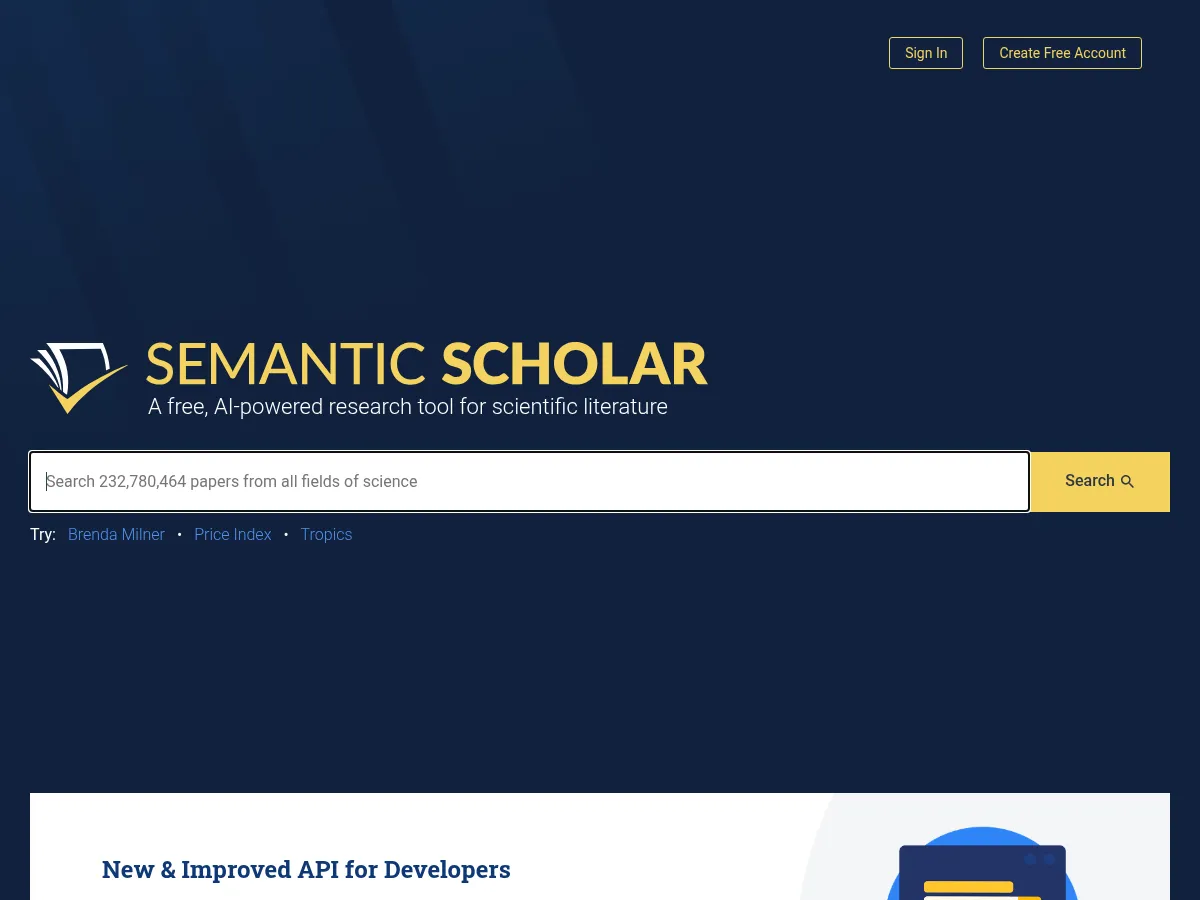
Semantic Scholar, developed by the Allen Institute for AI, is one of the most powerful free academic search engines available. With over 200 million papers indexed, it leverages AI to surface relevant research through semantic understanding rather than simple keyword matching. Its TLDR feature provides concise AI-generated summaries of papers, while citation context and influence scores help researchers quickly assess a paper's impact and relevance.
The platform's open API is a standout feature, enabling developers to build custom research tools and integrate scholarly data into workflows. The knowledge graph connecting papers, authors, and topics is exceptionally well-structured, making literature discovery intuitive and efficient.
Strengths include its completely free access, robust API, citation analysis tools, and the Semantic Reader for enhanced paper comprehension. Limitations include occasional gaps in non-English literature coverage, and the AI summarization, while useful, can oversimplify nuanced findings. The interface is clean but could benefit from more advanced filtering options. For academic researchers and anyone navigating scientific literature, Semantic Scholar is an indispensable tool that genuinely democratizes access to knowledge.
 Powered by Rexiew