About

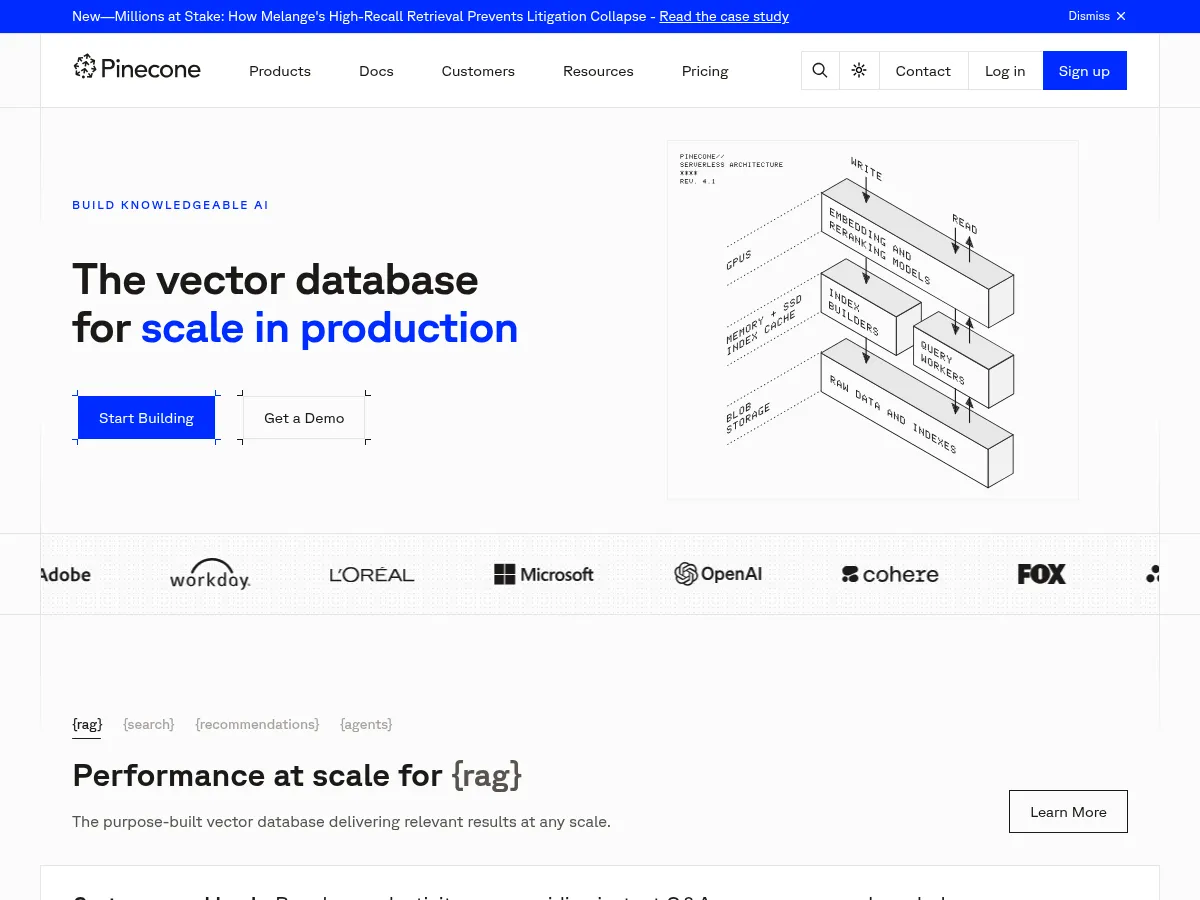
Pinecone is a managed vector database designed specifically for AI applications that require high-performance similarity search at scale. Founded in 2019 by Edo Liberty, a former director of Amazon AI Labs, Pinecone provides a cloud-native infrastructure for storing, indexing, and querying high-dimensional vector embeddings generated by machine learning models. Vector databases are essential components of modern AI systems, enabling capabilities like semantic search, recommendation engines, retrieval-augmented generation (RAG), anomaly detection, and deduplication by finding similar items based on the mathematical representations of their content rather than exact keyword matches. Pinecone differentiates itself through its fully managed approach, handling the complexities of vector indexing algorithms, distributed infrastructure, replication, and scaling automatically. Users simply upload their vectors and query them through a straightforward API, without needing to manage servers, tune index parameters, or handle infrastructure maintenance. The platform supports namespaces for data organization, metadata filtering for combining vector similarity with traditional attribute-based filtering, and sparse-dense hybrid search for improved retrieval accuracy. Pinecone operates on a serverless architecture that scales automatically based on usage and stores data durably across availability zones. It offers client libraries for Python, Node.js, Java, and Go, along with integrations with popular AI frameworks including LangChain, LlamaIndex, and Haystack. The platform provides a free Starter tier with limited storage and queries, a Standard tier with pay-as-you-go pricing based on storage and compute consumption, and an Enterprise tier with dedicated infrastructure, higher limits, SSO, and premium support. Pinecone has become one of the most widely adopted vector databases in the AI industry.

AI Data Analysis

Pinecone enables AI-powered data analysis through semantic similarity search, allowing organizations to find patterns, detect anomalies, identify duplicates, and discover relationships within large datasets based on vector representations rather than exact matches, powering advanced analytical workflows.

AI RAG Tools

Pinecone is a foundational component in retrieval-augmented generation pipelines, storing document embeddings and enabling fast semantic retrieval of relevant context for LLM queries. Its integrations with LangChain, LlamaIndex, and other RAG frameworks make it a standard choice for building knowledge-grounded AI applications.

AI Vector Databases

Pinecone is one of the most widely adopted managed vector databases, purpose-built for storing and querying high-dimensional embeddings at scale. It provides low-latency similarity search with metadata filtering, serverless scaling, and a simple API, serving as the vector storage backbone for thousands of AI applications.

Tool Details Freemium

Pricing Freemium (Free Starter / Pay-as-you-go Standard / Custom Enterprise)
Platform API, SaaS
Headquarters San Francisco, CA
Founded 2019
Free Plan Yes
API Available Yes
Enterprise Plan Yes
4.5
2 reviews
Ease of Use
4.7
Processing Speed
4.7
Accuracy and Reliability
4.5
Integration Flexibility
4.5
Insight Depth
2.5
Data Visualization
2
Claude Opus 4.6
AI Review
4.4/5

Pinecone is a leading fully managed vector database purpose-built for AI applications, particularly excelling in similarity search and retrieval-augmented generation (RAG) workflows. Its serverless architecture eliminates infrastructure management, letting developers focus on building rather than ops. The API is clean, well-documented, and supports multiple SDKs (Python, Node.js, Java, Go), making integration straightforward. Metadata filtering, namespaces, and sparse-dense hybrid search give it strong flexibility for production RAG pipelines. The free Starter tier is generous enough for prototyping, while pay-as-you-go pricing scales reasonably"though costs can climb with large-scale deployments compared to self-hosted alternatives like Milvus or Weaviate. As a pure vector database, its direct data analysis capabilities are limited; it's a retrieval layer rather than an analytics engine. Performance is consistently fast with low-latency queries even at scale. The managed nature and reliability make it an excellent choice for teams wanting a production-ready vector store without operational overhead, though power users seeking full control may prefer open-source options.

Ease of Use
4.7
Processing Speed
4.7
Accuracy and Reliability
4.5
Integration Flexibility
4.5
Insight Depth
2.5
Data Visualization
2
Feb 15, 2026