GPTZero
About
AI Content Detectors
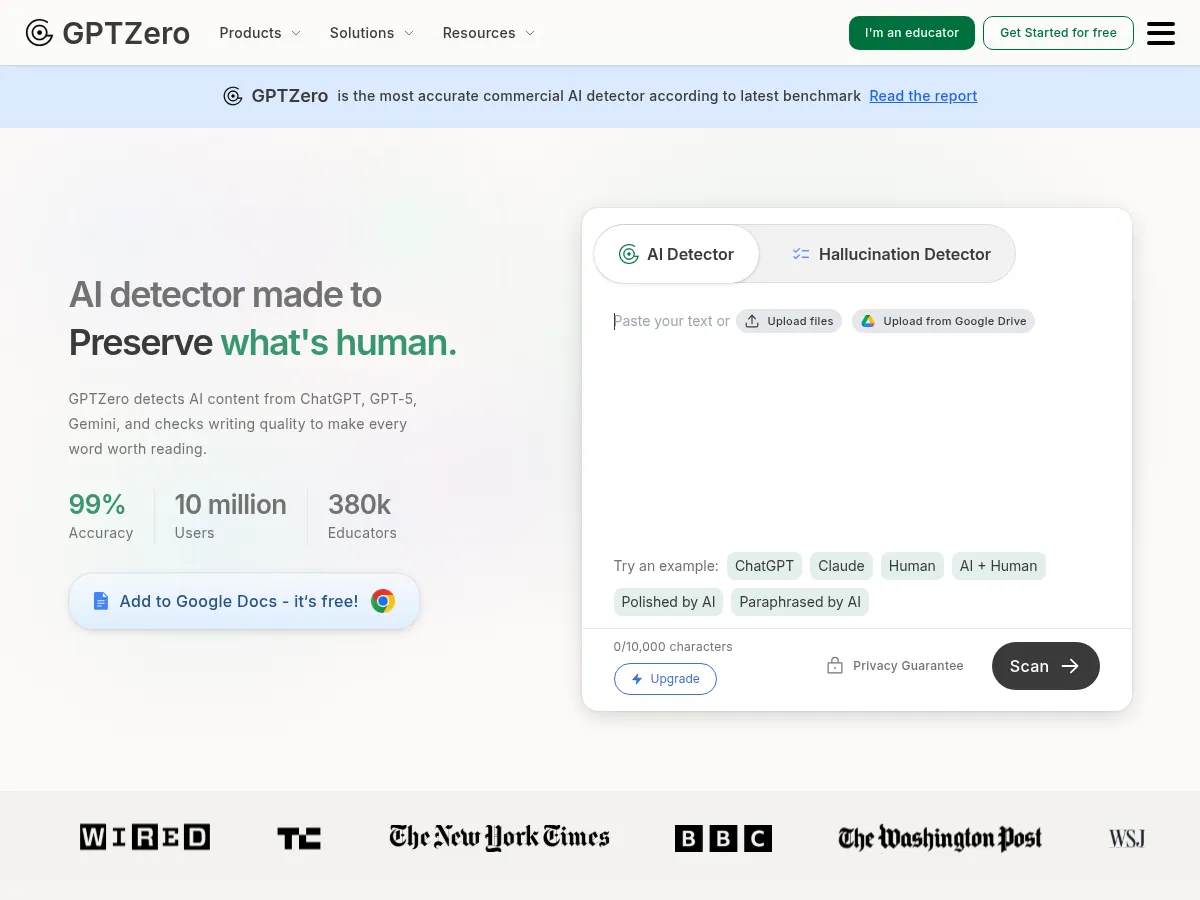
GPTZero is one of the most widely recognized AI content detection tools, capable of identifying text generated by ChatGPT, GPT-4, Claude, Gemini, and other large language models. It provides document-level and sentence-level detection scores using perplexity and burstiness analysis, highlighting specific passages most likely to be AI-generated for transparent and granular results.
AI Content Moderation
GPTZero supports content moderation workflows by enabling organizations to verify whether submitted text is human-written or AI-generated. Publishers, hiring managers, and content platforms use it to screen submissions for AI-generated content, maintaining quality standards and authenticity policies across their content ecosystems.
AI Safety Tools
GPTZero contributes to AI safety by providing transparency tools that help identify AI-generated text in contexts where authenticity matters. Its detection capabilities support responsible AI use by enabling institutions to enforce policies around AI-generated content, preventing misuse in academic, journalistic, and professional settings.
Tool Details Freemium
GPTZero has established itself as one of the leading AI content detection tools, widely adopted by educators, publishers, and organizations seeking to distinguish human-written text from AI-generated content. The platform analyzes text using perplexity and burstiness metrics, delivering sentence-level highlighting that shows exactly which portions are likely AI-generated " a genuinely useful feature for nuanced evaluation.
The freemium model is generous enough for casual users, while the $10/month Pro plan offers solid value for professionals needing higher volume scanning. Enterprise and API options make it viable for integration into larger workflows, which is a significant advantage over simpler detection tools. The API is well-documented and straightforward to implement.
Strengths include strong detection accuracy across multiple LLMs (GPT-4, Claude, Gemini), batch file uploads, and a clean, intuitive interface. However, like all AI detectors, it can produce false positives " particularly with non-native English writing or highly formulaic content. It also works best with longer text samples; short passages yield less reliable results.
Overall, GPTZero remains a top-tier choice in the AI detection space, balancing accessibility with robust functionality.
GPTZero stands out as a pioneer in the AI detection landscape, offering a robust solution for educators, editors, and platforms seeking to distinguish between human and machine-generated text. By analyzing metrics like "perplexity" and "burstiness," it provides a nuanced probability score rather than a simple binary result, which adds necessary transparency to the analysis. The platform is highly accessible, featuring a user-friendly web interface and a Freemium pricing model that caters to casual users while offering affordable Pro tiers for heavier workloads.
For developers and enterprises, the availability of a comprehensive API allows for seamless integration into automated content moderation workflows. However, users should remain aware of the inherent limitations of current AI detection technology; while GPTZero is among the most accurate tools available, false positives can occur, and highly paraphrased AI content may occasionally slip through. Overall, it serves as a valuable, albeit not infallible, layer of verification in an increasingly synthetic digital ecosystem.
 Powered by Rexiew