Waymo
About
AI Analytics Tools
Waymo's autonomous driving system performs real-time analytics on massive volumes of sensor data, using AI models to analyze traffic patterns, predict road user behavior, and make driving decisions. The company also uses large-scale data analytics in its simulation and testing infrastructure, analyzing millions of simulated and real-world driving scenarios to validate system safety.
AI Automation Tools
Waymo automates transportation through its fully driverless ride-hailing service Waymo One, removing the need for human drivers entirely. The autonomous driving system handles all aspects of vehicle operation including navigation, traffic management, pedestrian interaction, and parking, automating the entire transportation workflow from pickup to destination.
AI Research Tools
Waymo is a pioneer in autonomous driving research, having contributed extensively to advances in perception, prediction, planning, and simulation for self-driving vehicles. The company has published numerous research papers and datasets, including the Waymo Open Dataset, which is widely used by the academic community for autonomous driving research and benchmarking.
AI Robotics
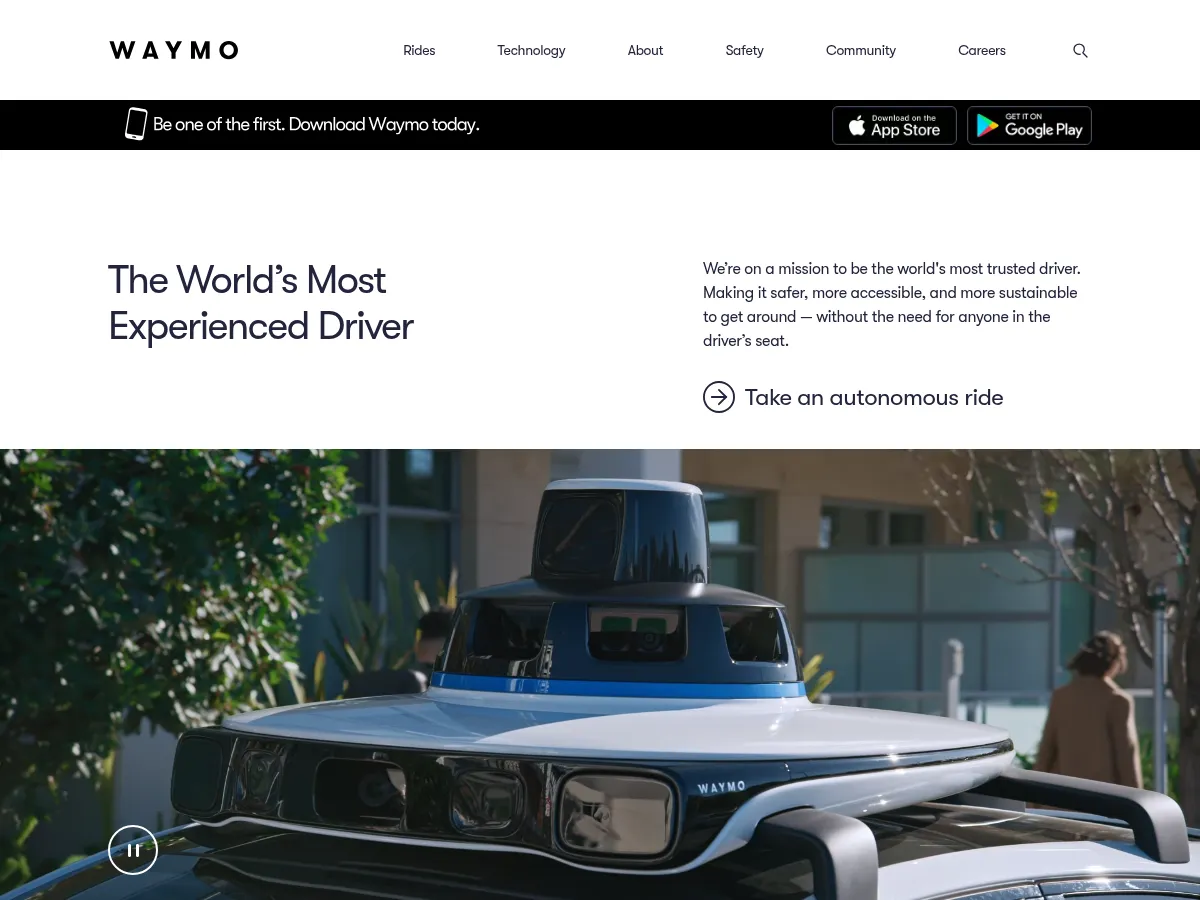
Waymo develops fully autonomous vehicles that function as mobile robots, using the Waymo Driver AI system to perceive, predict, and navigate complex urban environments without human intervention. The system integrates lidar, radar, and camera data through deep neural networks for real-time object detection, tracking, motion forecasting, and trajectory planning.
Tool Details Paid
Waymo, Alphabet's autonomous driving subsidiary, stands as arguably the most advanced self-driving technology platform commercially available today. Operating fully driverless ride-hailing services in Phoenix, San Francisco, and Los Angeles, Waymo has logged millions of autonomous miles with an impressive safety record that increasingly outperforms human drivers.
The technology stack combines LiDAR, cameras, and radar with sophisticated AI models trained on vast real-world and simulated datasets. As a robotics and automation achievement, it's genuinely groundbreaking " the seamless door-to-door experience rivals traditional ride-hailing. Per-ride pricing is competitive with Uber and Lyft, making it accessible where available.
Limitations include severely restricted geographic availability, occasional navigation quirks in complex scenarios, and no API or developer integration for third parties. Its analytics capabilities are primarily internal, powering route optimization and safety systems rather than offering user-facing analytical tools.
As a research platform, Waymo's published papers and open datasets (like the Waymo Open Dataset) are invaluable contributions to the autonomous driving community. For consumers in supported markets, it's a remarkable glimpse into AI's transformative potential in transportation.
 Powered by Rexiew