Pulumi AI
About
AI Automation Tools
Pulumi automates cloud infrastructure provisioning and management through programmatic infrastructure definitions with built-in state management. Pulumi Deployments enables automated infrastructure updates triggered by Git pushes, with drift detection that automatically remediates configuration drift, and policy-as-code enforcement through CrossGuard.
AI Code Assistants
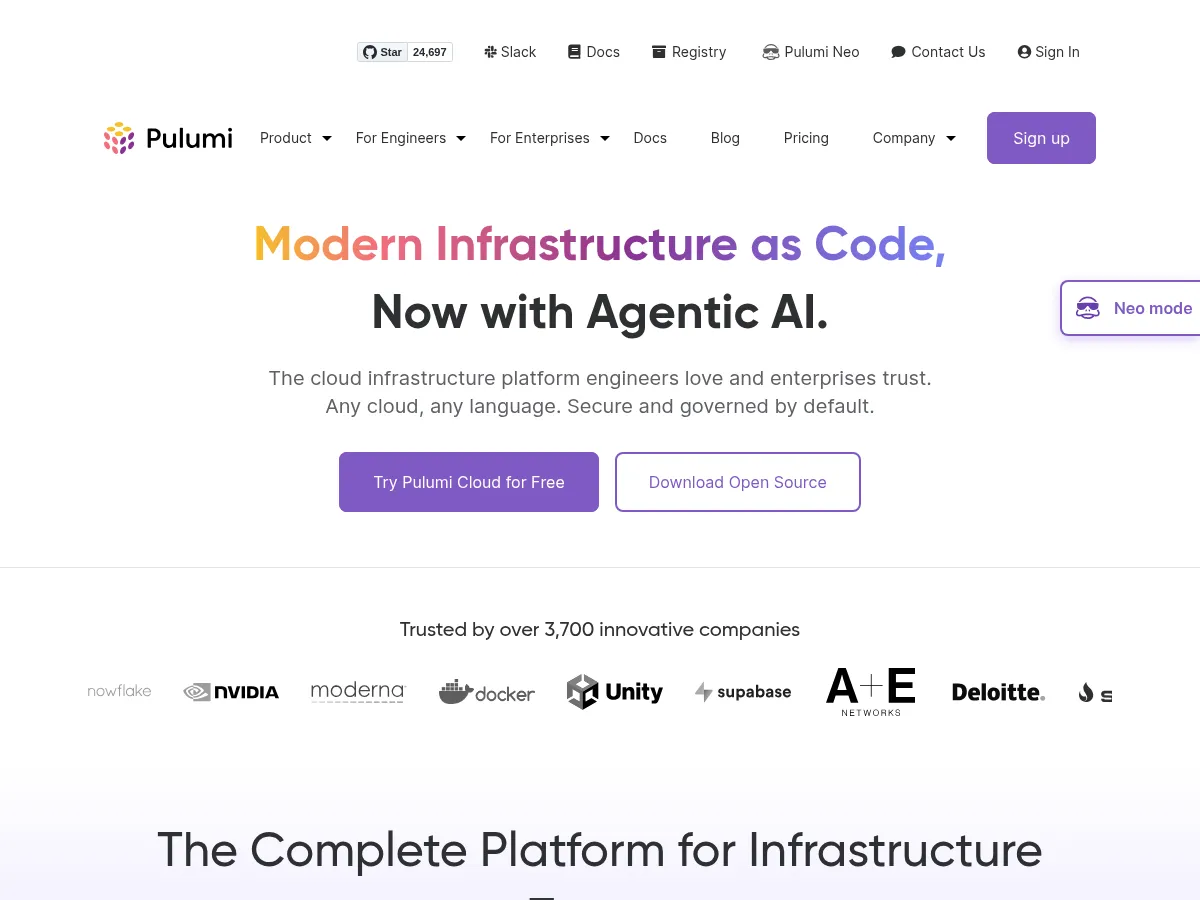
Pulumi AI functions as an intelligent assistant for infrastructure development, allowing developers to describe infrastructure needs conversationally and receive contextual code suggestions. It helps users iteratively build and refine infrastructure configurations, explains cloud concepts, and provides guidance on best practices for multi-cloud architectures.
AI Code Generators
Pulumi AI generates complete infrastructure as code programs from natural language descriptions in Python, TypeScript, Go, C#, Java, and other supported languages. Users describe their desired cloud architecture in plain English and receive working Pulumi programs, making infrastructure code generation accessible to developers without deep cloud expertise.
AI DevOps Tools
Pulumi provides AI-powered infrastructure as code for DevOps teams, enabling cloud resource provisioning using familiar programming languages. Pulumi AI generates infrastructure programs from natural language descriptions, while Pulumi Deployments provides GitOps-driven automation with drift detection. Its multi-cloud support and policy enforcement make it a comprehensive DevOps infrastructure tool.
Tool Details Freemium
Pulumi AI brings natural language-driven infrastructure-as-code generation to the DevOps world, allowing engineers to describe cloud infrastructure in plain English and receive deployable code in TypeScript, Python, Go, C#, or YAML. The tool excels at translating complex multi-cloud configurations into clean, well-structured Pulumi programs, significantly reducing the learning curve for cloud provisioning.
Strengths include its open-source foundation, multi-language support, and seamless integration with major cloud providers (AWS, Azure, GCP, Kubernetes). The freemium model is generous for individual developers, and the API availability enables powerful automation workflows. Pulumi's approach of using real programming languages rather than domain-specific ones gives it a significant edge over Terraform-based alternatives.
Limitations include occasional inaccuracies in generated code for niche cloud services, and complex multi-resource architectures sometimes require manual refinement. The $50/month team tier may feel steep for small teams. Despite these caveats, Pulumi AI represents one of the most practical applications of generative AI in the infrastructure space, making cloud automation substantially more accessible.
 Powered by Rexiew