About

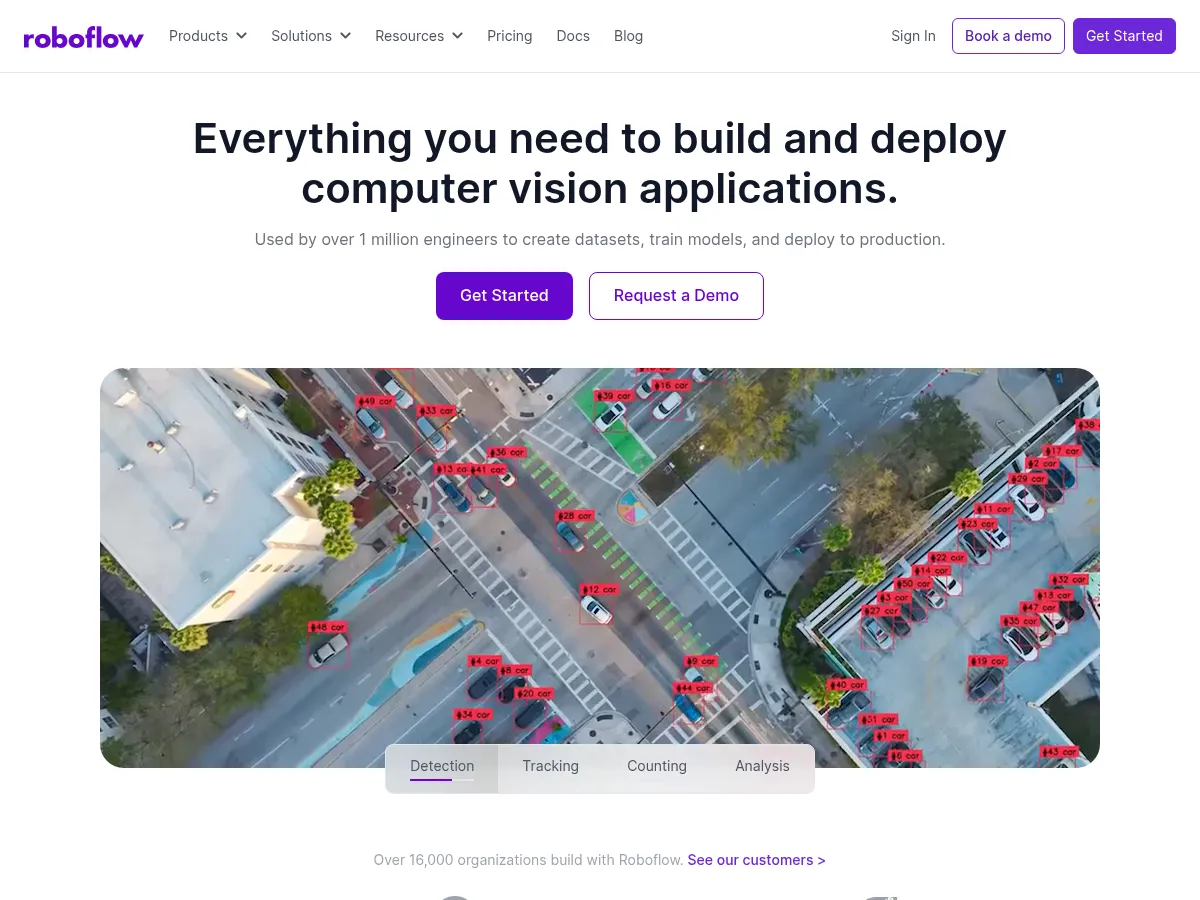
Roboflow is a computer vision platform that provides tools for building, training, deploying, and managing computer vision models, making it easier for developers and organizations to create applications that understand visual data. Founded in 2020 by Joseph Nelson and Brad Dwyer, the company is headquartered in Des Moines, Iowa. Roboflow provides an end-to-end workflow for computer vision projects, starting from data collection and annotation through model training and production deployment. The platform offers a web-based annotation tool for labeling images and videos with bounding boxes, polygons, keypoints, and segmentation masks. It supports assisted labeling features that use AI to speed up the annotation process through model-assisted labeling and automatic label suggestions. Roboflow Universe is a public repository hosting over 250,000 computer vision datasets and pre-trained models contributed by the community, which users can use as starting points for their own projects. The platform supports training models for object detection, image classification, instance segmentation, and semantic segmentation using popular architectures including YOLOv8, YOLO-NAS, and other state-of-the-art models. Roboflow also integrates with foundation models like SAM (Segment Anything Model) and CLIP for zero-shot and few-shot computer vision tasks. For deployment, Roboflow provides hosted inference APIs, edge deployment options for running models on devices like NVIDIA Jetson and Raspberry Pi, and SDKs for iOS, Android, and web applications. The Roboflow Inference server can be self-hosted for on-premises deployment requirements. The platform includes dataset management features such as version control, augmentation, preprocessing, and health checks that identify potential data quality issues. Roboflow offers a free tier for public projects, a Starter plan for individual developers, a Growth plan for teams, and an Enterprise plan with dedicated support, custom deployment options, and advanced security features.

AI Data Analysis

Roboflow includes data analysis features for computer vision projects, providing dataset health checks that identify class imbalances, annotation quality issues, and data distribution problems. These analytical tools help users understand and improve their training data quality before model training, leading to better model performance.

AI Image Models

Roboflow hosts and integrates computer vision models for image understanding tasks including object detection, image classification, instance segmentation, and semantic segmentation. The platform provides access to state-of-the-art architectures and foundation models like SAM and CLIP, along with Roboflow Universe's library of over 250,000 community datasets and pre-trained models.

AI MLOps Tools

Roboflow supports computer vision MLOps workflows through dataset version control, model training management, deployment orchestration, and inference monitoring. The platform provides tools for managing the lifecycle of computer vision models from data collection through production, including data health checks and model performance tracking.

AI Model Hosting

Roboflow provides hosted inference APIs for deploying computer vision models in production, with options for cloud hosting, edge deployment on devices like NVIDIA Jetson and Raspberry Pi, and self-hosted inference through the open-source Roboflow Inference server. This flexibility supports deployment across diverse environments from cloud to embedded devices.

AI Research Tools

Roboflow supports computer vision research through Roboflow Universe, a public repository of datasets and models, integration with state-of-the-art architectures, and tools for rapid experimentation. Researchers use the platform to benchmark models, share datasets, and accelerate computer vision research with standardized data management and training workflows.

AI Training Platforms

Roboflow provides an end-to-end training pipeline for computer vision models, supporting annotation, data augmentation, preprocessing, and model training for object detection, classification, and segmentation tasks. Users can train models using YOLOv8 and other architectures through the platform, with automated hyperparameter tuning and evaluation metrics.

Tool Details Freemium

Pricing Freemium (Free for public projects / $249/mo Starter / Custom Enterprise)
Platform SaaS,API,Self-hosted
Headquarters Des Moines, Iowa
Founded 2020
Free Plan Yes
API Available Yes
Open Source Yes
Enterprise Plan Yes
4.5 2 reviews

AI Reviews

🤖
4.5 /5

Roboflow has established itself as one of the most comprehensive end-to-end computer vision platforms available. It excels at streamlining the entire workflow"from dataset annotation and augmentation to model training and deployment"making it remarkably accessible even for teams without deep ML expertise.

The platform's annotation tools are intuitive, and its auto-labeling capabilities significantly reduce manual effort. Dataset management features like version control and preprocessing pipelines are genuinely well-designed. Training support for popular architectures (YOLOv8, Florence-2, etc.) with one-click training is a major time-saver.

The freemium model is generous for public projects, making it excellent for researchers and open-source contributors. The API is robust and well-documented, enabling seamless integration into production workflows. The open-source components (Inference, Supervision library) add tremendous value to the ecosystem.

Limitations include the $249/month jump for private projects, which may deter smaller teams. Model hosting inference speeds can vary, and advanced customization options are somewhat limited compared to building custom pipelines. Still, for computer vision specifically, Roboflow is hard to beat as an all-in-one solution.

Category Ratings

AI Data Analysis
4.2
AI Image Models
4.7
AI MLOps Tools
4.5
AI Model Hosting
4.4
AI Research Tools
4.3
AI Training Platforms
4.6
Feb 15, 2026
AI-Generated Review Generated via Anthropic API. This is an automated evaluation, not a consumer review. Learn more
🤖
4.5 /5

Roboflow has established itself as a comprehensive end-to-end platform for computer vision projects, excelling particularly in image annotation, dataset management, and model training workflows. The platform's intuitive interface makes it accessible for beginners while offering powerful features for experienced ML engineers.

Key strengths include excellent data augmentation tools, seamless integration with popular frameworks like YOLO and TensorFlow, and robust API support for automation. The free tier for public projects is generous, making it ideal for researchers and hobbyists. Dataset versioning and collaborative features streamline team workflows effectively.

The $249/month Starter plan may feel steep for small teams, and while the platform excels at object detection and classification, it's less optimized for other computer vision tasks. Some advanced MLOps features require enterprise pricing.

Overall, Roboflow delivers exceptional value for teams focused on visual AI, offering a polished experience from data labeling through deployment. Its open-source components and active community further enhance its appeal.

Category Ratings

AI Data Analysis
4.3
AI Image Models
4.7
AI MLOps Tools
4.5
AI Model Hosting
4.4
AI Research Tools
4.2
AI Training Platforms
4.6
Feb 12, 2026
AI-Generated Review Generated via Anthropic API. This is an automated evaluation, not a consumer review. Learn more