CVAT
Über uns
KI-Synthetische Daten
CVAT ist Intels Open-Source-Datenmarkierungsplattform mit AI-gestützter Annotation für das Training von Computer-Vision-Modellen.
Tool-Details Kostenlos
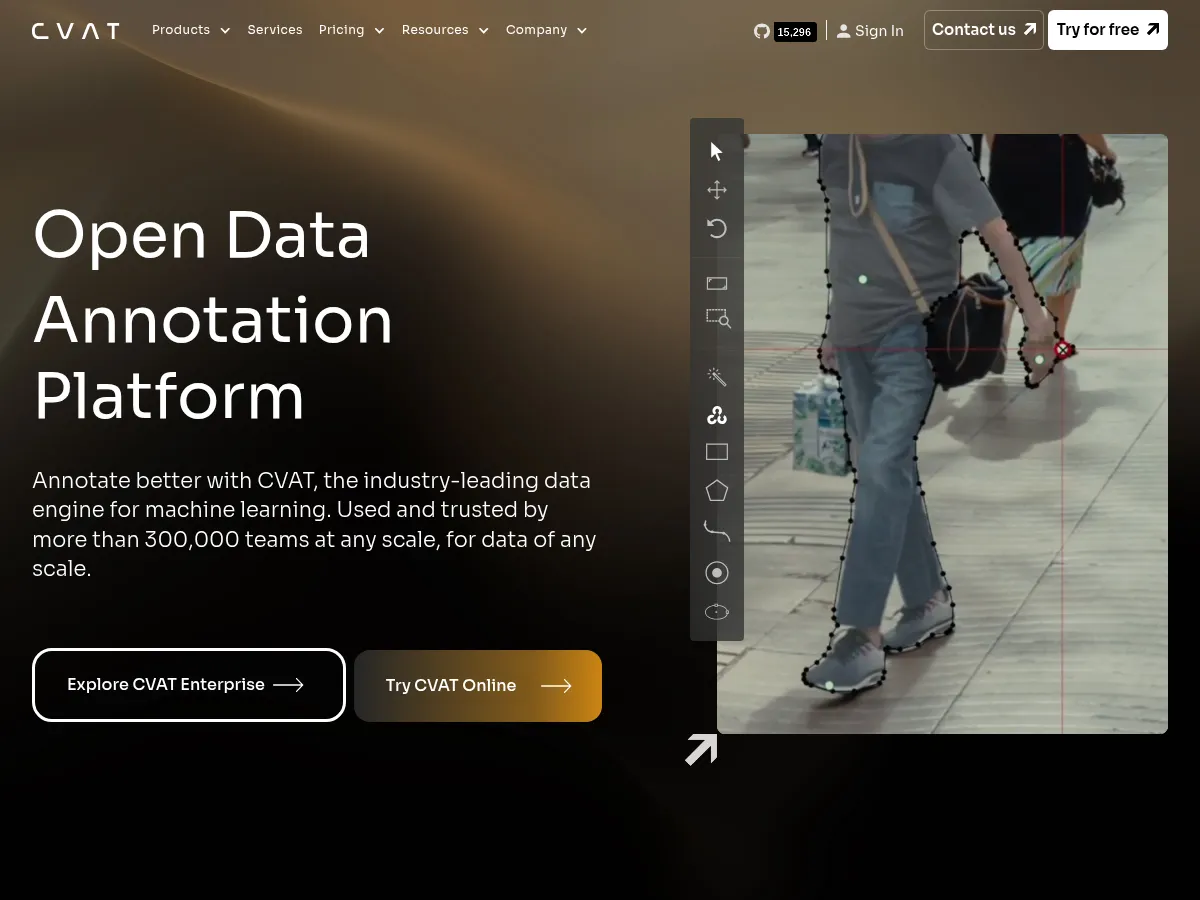
CVAT (Computer Vision Annotation Tool) is a powerful, open-source data annotation platform originally developed by Intel. It excels at image and video labeling for computer vision tasks, supporting bounding boxes, polygons, polylines, keypoints, and cuboids. The web-based interface is intuitive and supports collaborative workflows, making it ideal for teams building training datasets. Being fully open-source and free is a massive advantage " self-hosting gives complete data control, while cvat.ai offers a cloud option. The API is well-documented, enabling automation of annotation pipelines. However, it's important to note that CVAT is fundamentally an annotation tool, not a synthetic data generator. While it plays a critical role in the data pipeline for AI model training, it doesn't generate artificial datasets the way dedicated synthetic data platforms like Datagen or Synthesis AI do. Integration with AI-assisted labeling (via deep learning models) partially bridges this gap. For teams needing robust, free annotation capabilities, CVAT is hard to beat " but those specifically seeking synthetic data generation should look elsewhere.
CVAT (Computer Vision Annotation Tool) is an industry-standard, open-source platform designed for efficient computer vision data management. While its primary function is high-precision annotation rather than direct synthetic data generation, it serves as a critical infrastructure tool for validating and refining the datasets required to train generative models. The platform supports a comprehensive range of tasks, including bounding boxes, polygons, and video annotation, enhanced by semi-automatic labeling features that significantly reduce manual effort.
As a completely free and self-hosted solution with a robust API, CVAT offers enterprise-grade capabilities that rival expensive SaaS competitors like Labelbox. Developers will appreciate its extensibility and Docker-based deployment, though the initial setup and server management may present a slight learning curve for non-technical users. It remains an indispensable tool for teams building high-quality computer vision pipelines.
 Powered by Rexiew