Google What-If Tool
소개
AI 편향 탐지
Google What-If Tool은 소그룹 분석을 통해 ML 공정성과 편향을 조사하기 위한 오픈소스 인터페이스입니다.
도구 세부정보 무료
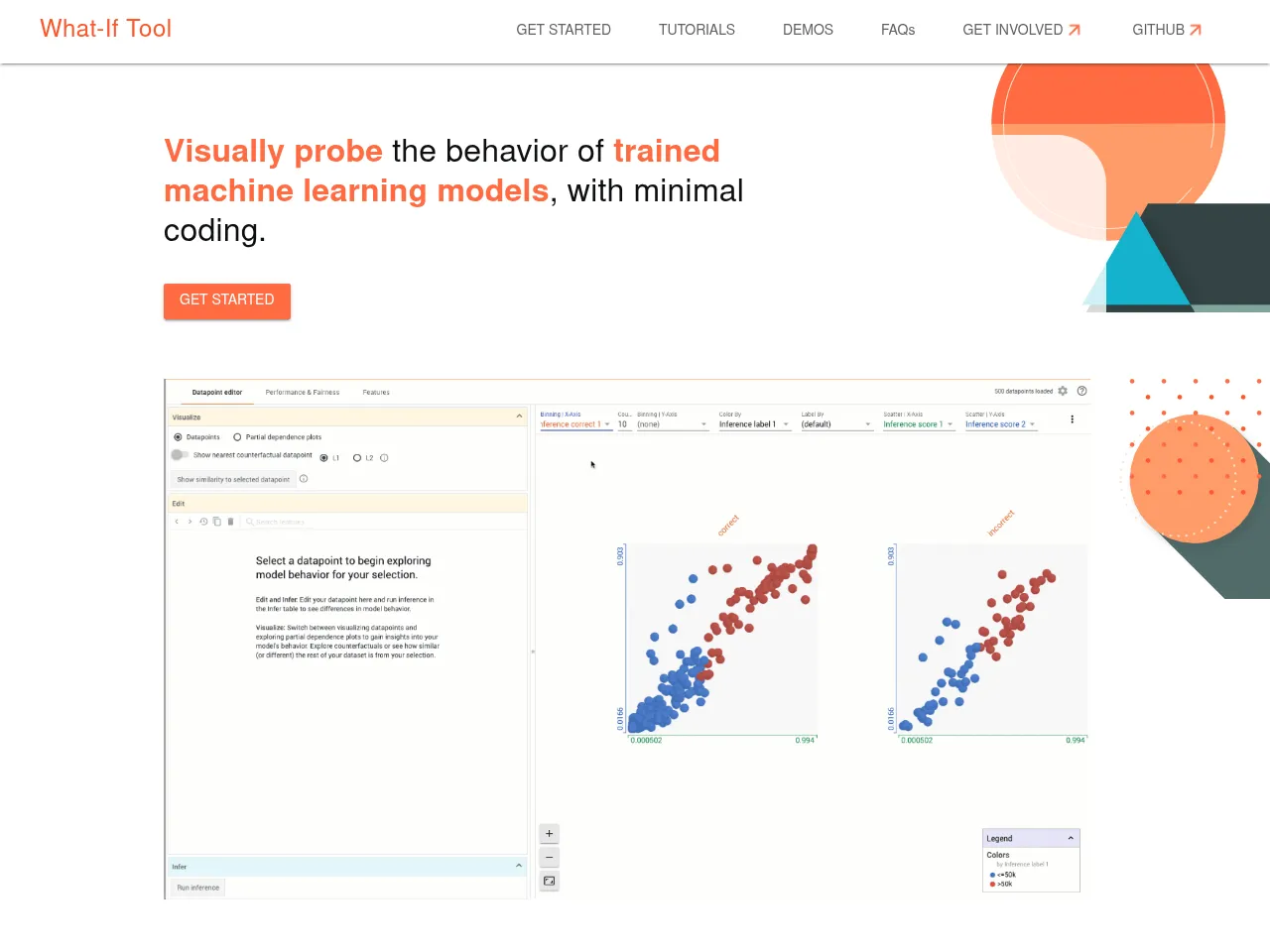
Google's What-If Tool is a powerful, open-source visualization tool for probing machine learning models without writing code. Developed by Google's PAIR initiative, it excels at bias detection by enabling users to explore model performance across different demographic slices, compare fairness metrics, and analyze individual data points through intuitive visual interfaces. The tool integrates seamlessly with TensorFlow and TensorBoard, and also supports custom prediction functions for non-TF models. Its standout features include automatic fairness metric computation (demographic parity, equal opportunity, etc.), counterfactual analysis, and partial dependence plots. The interactive datapoint editor lets users modify features and instantly see prediction changes, which is invaluable for understanding model behavior. Limitations include a learning curve for interpreting complex visualizations, and it works best within the TensorFlow/Jupyter ecosystem " integration with other frameworks requires additional setup. Documentation could be more comprehensive for advanced use cases. Being completely free and open source makes it an exceptional value proposition, especially for teams already in the Google ML ecosystem. It remains one of the most robust bias detection tools available.
The Google What-If Tool (WIT) stands out as an essential, open-source resource for data scientists and ML engineers dedicated to responsible AI development. Developed by Google's PAIR team, it offers an interactive visual interface to probe machine learning models without writing complex code for every query. Its core strength lies in counterfactual analysis"allowing users to tweak data points and instantly see how model predictions shift"which is invaluable for uncovering hidden biases.
While it excels in visualization and works seamlessly within Jupyter Notebooks, Colab, and TensorBoard, it does have a learning curve. It is primarily designed for technical users rather than business stakeholders, meaning setup requires some coding proficiency. However, given its robust feature set for slicing data and comparing performance across subgroups, combined with being completely free, it remains a benchmark tool for fairness auditing. It is a must-have in the toolkit for anyone serious about model interpretability and bias mitigation.
 Powered by Rexiew