Demucs
Om
AI for separasjon av musikkstems
Demucs er Metas åpen kildekode-modell for høykvalitets musikkildeadskillelse inn i vokal, trommer, bass og andre stemmer.
Verktøydetaljer Gratis
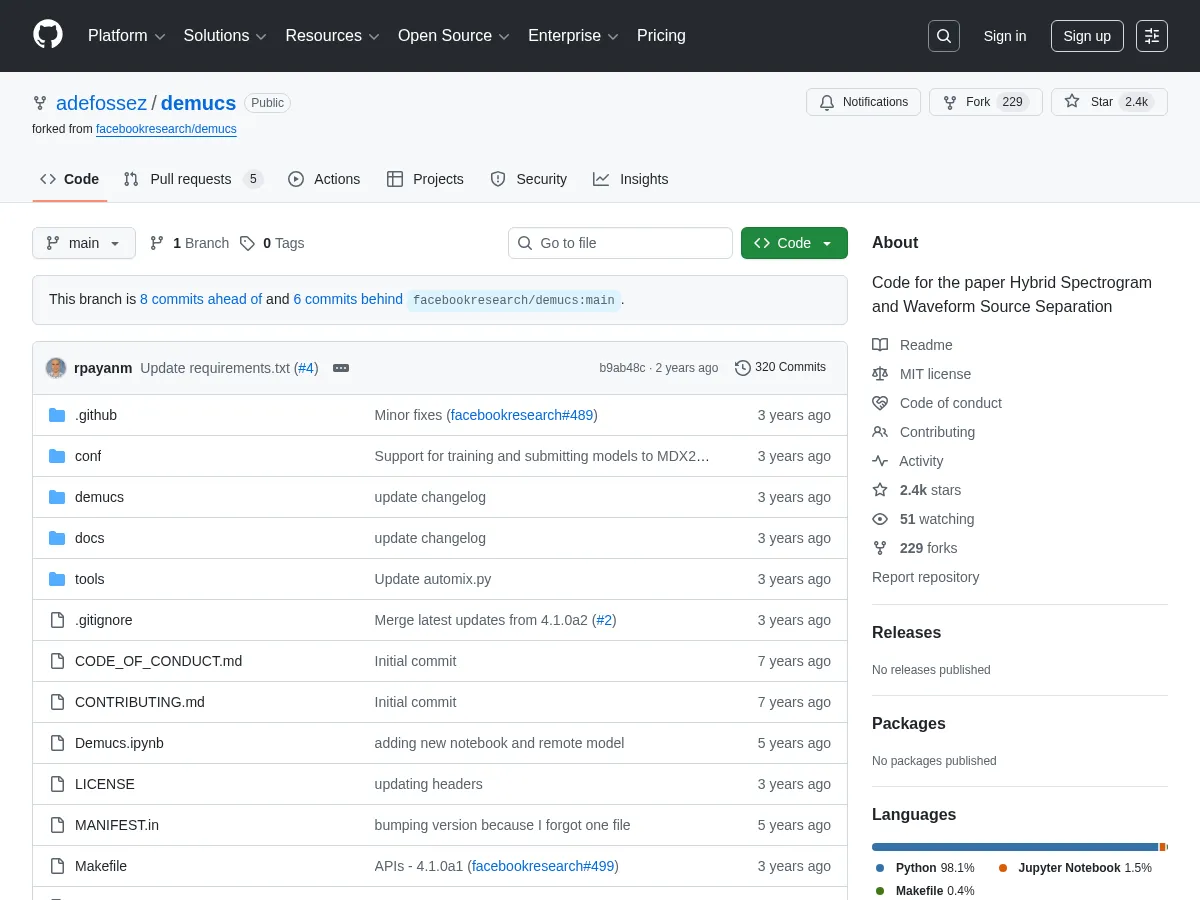
Demucs, developed by Meta's FAIR team, is one of the most impressive open-source music source separation tools available. Built on a hybrid transformer architecture, it excels at isolating vocals, drums, bass, and other stems from mixed audio tracks with remarkable clarity and minimal artifacts. The latest version (Demucs v4/HTDemucs) represents a significant leap in separation quality, often rivaling or surpassing commercial alternatives. Being completely free and open-source is a massive advantage " users can run it locally with full control over their data. Installation requires some Python familiarity, which may deter non-technical users, but community-built GUIs help bridge that gap. GPU acceleration is supported but not required, though CPU-only processing can be slow on longer tracks. The model handles complex mixes well, though heavily layered or lo-fi recordings can still produce some bleed between stems. Compared to paid services like LALAL.AI or iZotope RX, Demucs delivers competitive quality at zero cost, making it the gold standard for open-source stem separation.
Demucs stands out as a state-of-the-art open-source music source separation model, offering professional-grade stem isolation without the subscription costs associated with commercial alternatives. Developed by Facebook AI Research, it utilizes a sophisticated hybrid Transformer/Convnet architecture to split audio tracks into drums, bass, vocals, and other instruments with remarkable clarity and minimal artifacting. While the audio quality is often superior to older tools like Spleeter, the primary barrier is usability; as a command-line tool hosted on GitHub, it requires some technical proficiency with Python to set up and run effectively. However, for developers and audio engineers willing to navigate the installation, it provides an unbeatable value proposition. It runs locally, ensuring data privacy, but does require decent hardware resources (preferably a GPU) to achieve reasonable processing speeds.
 Powered by Rexiew