AlphaFold
حول
تحليل البيانات بالذكاء الاصطناعي
يقوم AlphaFold بإجراء تحليل بيانات متقدم مدفوع بالذكاء الاصطناعي من خلال تفسير تسلسلات الأحماض الأمينية والمحاذاة متعددة التسلسل للتنبؤ بهياكل البروتين ثلاثية الأبعاد المعقدة. يعالج النظام كميات ضخمة من البيانات التطورية والهيكلية من خلال شبكات عصبية عميقة لإنشاء تنبؤات دقيقة جداً على المستوى الذري، مما يمثل أحد أكثر تطبيقات تحليل بيانات الذكاء الاصطناعي تطوراً في العلوم.
اكتشاف الأدوية بالذكاء الاصطناعي
لقد غيّر AlphaFold اكتشاف الأدوية في مراحله المبكرة من خلال تمكين الباحثين من التنبؤ بالهياكل ثلاثية الأبعاد لبروتينات الهدف بدقة قريبة من الدقة التجريبية. تستخدم شركات الأدوية والمختبرات الأكاديمية AlphaFold لتحديد مواقع الارتباط وفهم تفاعلات البروتين والليجاند وتصميم جزيئات علاجية جديدة، مما يقلل بشكل كبير من الوقت والتكلفة المرتبطة بتحديد الهيكل في خط أنابيب تطوير الأدوية.
أدوات الرعاية الصحية بالذكاء الاصطناعي
يساهم AlphaFold في الرعاية الصحية من خلال توفير رؤى هيكلية للباحثين حول البروتينات المرتبطة بالمرض، مما يتيح فهماً أفضل للاضطرابات الوراثية والأمراض المعدية وبيولوجيا السرطان. تساعد تنبؤاته العلماء على توضيح الآليات الجزيئية الكامنة وراء الأمراض وتدعم تطوير العلاجات الموجهة والأدوات التشخيصية.
أدوات البحث العلمي بالذكاء الاصطناعي
يعمل AlphaFold كأداة بحث ذكاء اصطناعي أساسية لعلماء الأحياء الجزيئية والكيميائيين الحيويين وعلماء الأحياء الهيكلية في جميع أنحاء العالم. تقدم قاعدة بيانات AlphaFold التي تضم أكثر من 200 مليون هيكل متوقع إمكانية الوصول الفوري إلى المعلومات الهيكلية التي كانت تتطلب سابقاً أشهراً أو سنوات من العمل التجريبي، مما يسرع البحث عبر المجالات بما في ذلك الجينوميات وعلم الأحياء التطوري والبيولوجيا الاصطناعية وهندسة البروتين.
تفاصيل الأداة مجاني
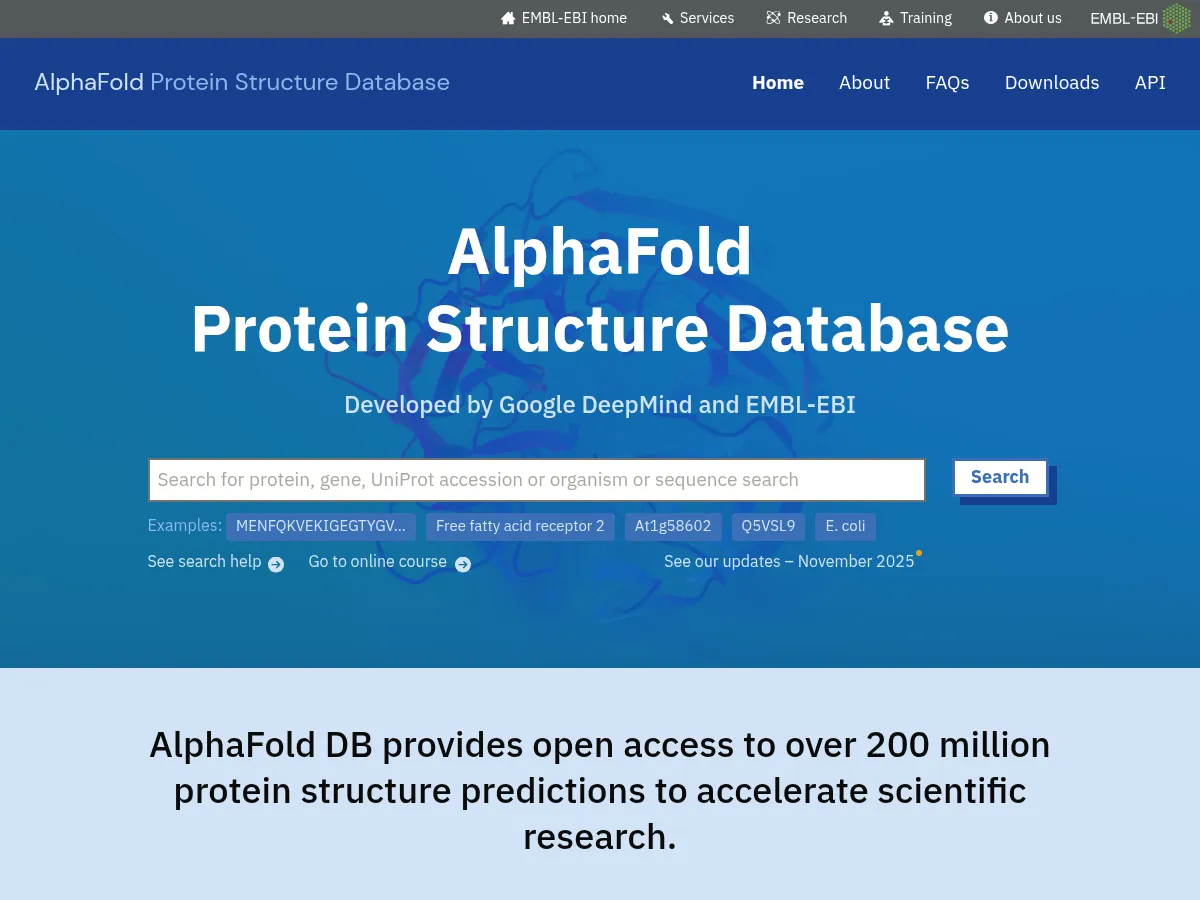
AlphaFold, developed by DeepMind, represents one of the most transformative AI breakthroughs in modern science. It predicts 3D protein structures from amino acid sequences with remarkable accuracy, effectively solving a 50-year grand challenge in biology. The AlphaFold Protein Structure Database, hosted by EMBL-EBI, now contains over 200 million predicted structures"covering nearly every known protein"all freely accessible.
Strengths are numerous: it's completely free and open source, offers API access for programmatic queries, and integrates seamlessly into existing research workflows. The accuracy rivals experimental methods like X-ray crystallography for many proteins, dramatically accelerating research timelines from months to minutes.
For drug discovery, AlphaFold is a game-changer, enabling researchers to understand target protein structures without costly lab work. Its impact on healthcare research, from understanding disease mechanisms to designing therapeutics, is already profound.
Limitations include reduced accuracy for intrinsically disordered regions, protein complexes, and conformational dynamics. It predicts static structures rather than dynamic behavior. Despite these caveats, AlphaFold remains an indispensable tool that has fundamentally reshaped structural biology and computational drug design.
AlphaFold, developed by DeepMind in partnership with EMBL-EBI, represents a paradigm shift in structural biology. By utilizing advanced deep learning architectures, it predicts the 3D structure of proteins from their amino acid sequences with near-experimental accuracy, effectively solving a decades-old grand challenge. The platform offers an accessible, searchable database containing over 200 million protein structure predictions, making it an invaluable resource for researchers worldwide.
For drug discovery and fundamental biological research, AlphaFold is indispensable, significantly accelerating timelines that previously relied on costly and time-consuming experimental methods like X-ray crystallography. Being open-source and free to use democratizes access to high-level structural data. However, while the database is easy to navigate, running the model locally for novel sequences requires significant computational resources and technical expertise. Additionally, while excellent at static structures, it is still evolving to better handle protein-ligand interactions and dynamic states compared to experimental verification. Overall, AlphaFold is a landmark AI achievement that is reshaping the life sciences.
 Powered by Rexiew