AlphaFold
เกี่ยวกับ
การวิเคราะห์ข้อมูลด้วย AI
AlphaFold ดำเนินการวิเคราะห์ข้อมูลขั้นสูงโดยใช้ปัญญาประดิษฐ์โดยตีความลำดับกรดอะมิโนและการจัดตำแหน่งลำดับหลายลำดับเพื่อทำนายโครงสร้างโปรตีนสามมิติที่ซับซ้อน ระบบประมวลผลข้อมูลวิวัฒนาการและโครงสร้างจำนวนมหาศาลผ่านเครือข่ายประสาทเทียมเชิงลึกเพื่อสร้างการทำนายในระดับอะตอมที่มีความแม่นยำสูง ซึ่งแสดงถึงการประยุกต์ใช้ปัญญาประดิษฐ์ในการวิเคราะห์ข้อมูลที่สำคัญที่สุดในด้านวิทยาศาสตร์
การค้นพบยาด้วย AI
AlphaFold ได้ปฏิวัติการค้นหายาในระยะเริ่มต้นโดยเปิดให้นักวิจัยคาดการณ์โครงสร้างสามมิติของโปรตีนเป้าหมายด้วยความแม่นยำใกล้เคียงกับการทดลอง บริษัทเภสัชกรรมและห้องปฏิบัติการวิชาการใช้ AlphaFold เพื่อระบุไซต์ยึดเกาะ ทำความเข้าใจปฏิสัมพันธ์ระหว่างโปรตีนและลิแกนด์ และออกแบบโมเลกุลการรักษาแบบใหม่ ซึ่งลดเวลาและต้นทุนที่เกี่ยวข้องกับการกำหนดโครงสร้างในกระบวนการพัฒนายาอย่างมีนัยสำคัญ
เครื่องมือดูแลสุขภาพด้วย AI
AlphaFold มีส่วนช่วยด้านสุขภาพโดยให้ข้อมูลเชิงลึกด้านโครงสร้างเกี่ยวกับโปรตีนที่เกี่ยวข้องกับการเจ็บป่วยแก่นักวิจัย ซึ่งช่วยให้เข้าใจความผิดปกติทางพันธุกรรม โรคติดเชื้อ และชีววิทยาของมะเร็งได้ดีขึ้น การทำนายของมันช่วยให้นักวิทยาศาสตร์สามารถอธิบายกลไกโมเลกุลที่อยู่เบื้องหลังโรคและสนับสนุนการพัฒนาของการรักษาที่เน้นเป้าหมายและเครื่องมือวินิจฉัย
เครื่องมือวิจัยด้วย AI
AlphaFold ทำหน้าที่เป็นเครื่องมือวิจัยปัญญาประดิษฐ์ขั้นพื้นฐานสำหรับนักชีววิทยาโมเลกุล ชีววิทยาเคมี และชีววิทยาโครงสร้างทั่วโลก ฐานข้อมูลของโปรตีนที่ทำนายได้กว่า 200 ล้านชนิดประเภทนี้ให้การเข้าถึงข้อมูลโครงสร้างที่ทันทีซึ่งเดิมต้องการงานการทดลองนานหลายเดือนหรือปี เพื่อเร่งการวิจัยในสาขาต่างๆ รวมถึงวิทยาศาสตร์พันธุกรรม ชีววิทยาวิวัฒนาการ ชีววิทยาสังเคราะห์ และวิศวกรรมโปรตีน
รายละเอียดเครื่องมือ ฟรี
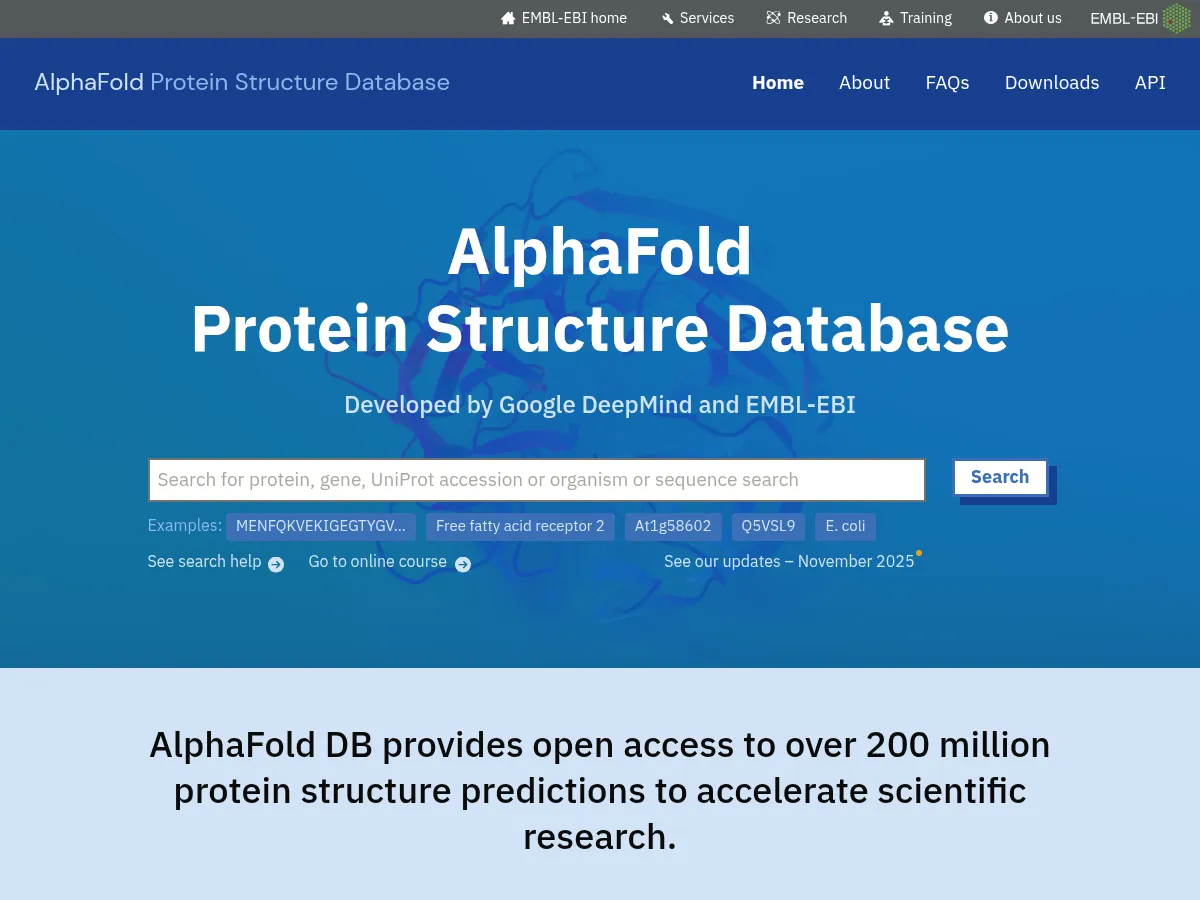
AlphaFold, developed by DeepMind, represents one of the most transformative AI breakthroughs in modern science. It predicts 3D protein structures from amino acid sequences with remarkable accuracy, effectively solving a 50-year grand challenge in biology. The AlphaFold Protein Structure Database, hosted by EMBL-EBI, now contains over 200 million predicted structures"covering nearly every known protein"all freely accessible.
Strengths are numerous: it's completely free and open source, offers API access for programmatic queries, and integrates seamlessly into existing research workflows. The accuracy rivals experimental methods like X-ray crystallography for many proteins, dramatically accelerating research timelines from months to minutes.
For drug discovery, AlphaFold is a game-changer, enabling researchers to understand target protein structures without costly lab work. Its impact on healthcare research, from understanding disease mechanisms to designing therapeutics, is already profound.
Limitations include reduced accuracy for intrinsically disordered regions, protein complexes, and conformational dynamics. It predicts static structures rather than dynamic behavior. Despite these caveats, AlphaFold remains an indispensable tool that has fundamentally reshaped structural biology and computational drug design.
AlphaFold, developed by DeepMind in partnership with EMBL-EBI, represents a paradigm shift in structural biology. By utilizing advanced deep learning architectures, it predicts the 3D structure of proteins from their amino acid sequences with near-experimental accuracy, effectively solving a decades-old grand challenge. The platform offers an accessible, searchable database containing over 200 million protein structure predictions, making it an invaluable resource for researchers worldwide.
For drug discovery and fundamental biological research, AlphaFold is indispensable, significantly accelerating timelines that previously relied on costly and time-consuming experimental methods like X-ray crystallography. Being open-source and free to use democratizes access to high-level structural data. However, while the database is easy to navigate, running the model locally for novel sequences requires significant computational resources and technical expertise. Additionally, while excellent at static structures, it is still evolving to better handle protein-ligand interactions and dynamic states compared to experimental verification. Overall, AlphaFold is a landmark AI achievement that is reshaping the life sciences.
 Powered by Rexiew