Groq
关于
AI GPU云
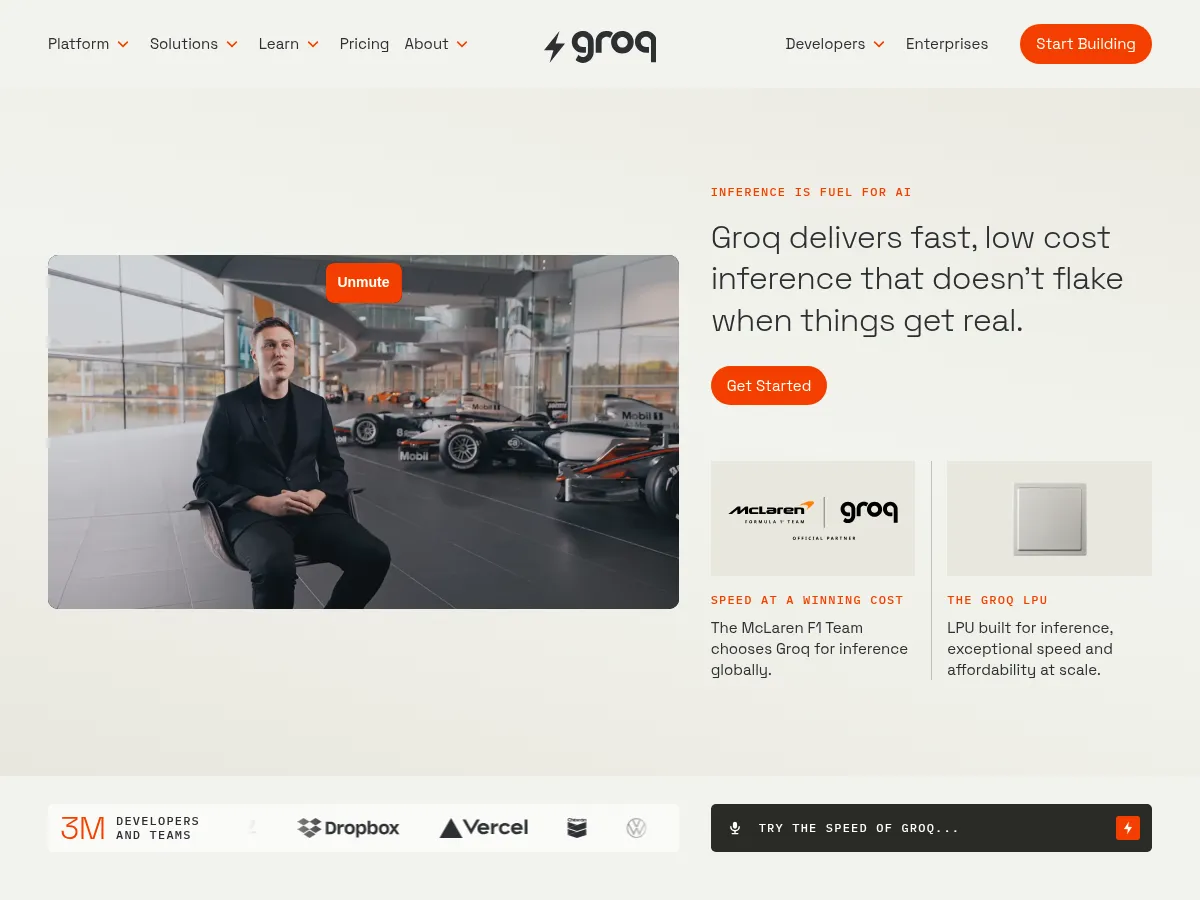
Groq 运营基于其专有 LPU(语言处理单元)芯片的云基础设施,该芯片专为 LLM 推理而设计。虽然不使用传统 GPU,但 Groq 提供 AI 计算云服务,包括共享 API 访问和专用 GroqRack 部署,供需要保障容量的组织使用。
AI模型托管
Groq 在其定制 LPU 硬件上托管和提供开源 AI 模型,提供可实现行业领先速度的托管推理基础设施。组织可以通过共享 API 访问模型,或部署专用 GroqRack 系统进行私有的、高吞吐量的模型服务。
LLM API
Groq 提供现有最快的 LLM 推理 API 之一,其提供流行开源模型的服务速度比基于 GPU 的替代方案快数倍。其 OpenAI 兼容 API 支持聊天完成、函数调用和流式传输,是对延迟敏感的应用的理想选择。
开源 LLM
Groq 通过其超快推理平台提供流行的开源语言模型,包括 LLaMA、Mistral、Mixtral 和 Gemma。其 LPU 硬件使这些开源模型能以比传统 GPU 基础设施快得多的速度运行,使其对实时应用更加实用。
工具详情 免费增值
Groq has carved out a distinctive niche by delivering blazingly fast inference speeds through its custom Language Processing Unit (LPU) hardware. The platform offers API access to popular open-source models like Llama 3, Mixtral, and Gemma at remarkably low latency " often 10-20x faster than competing providers. The generous free tier makes it accessible for experimentation, while pay-per-token pricing remains highly competitive for production workloads.
The API is OpenAI-compatible, making migration and integration straightforward. Developers can swap endpoints with minimal code changes, which is a significant practical advantage. Model selection focuses on quality open-source options rather than breadth, which keeps the offering focused.
Limitations include a narrower model catalog compared to platforms like Together AI or Replicate, and you're locked into Groq's infrastructure rather than choosing GPU types. The platform is inference-only " no fine-tuning support yet. Rate limits on the free tier can be restrictive during peak usage.
For developers prioritizing inference speed and cost-efficiency with open-source models, Groq is currently best-in-class.
Groq has rapidly established itself as a disruptor in the AI infrastructure space, distinguishing itself not with traditional GPUs, but with its proprietary Language Processing Units (LPUs). Designed specifically for inference, these chips deliver unparalleled speeds for open-source Large Language Models (LLMs) like Llama 3, Gemma, and Mixtral, making text generation feel nearly instantaneous. For developers, the value proposition is clear: lightning-fast latency at a highly competitive price point, accessible via an OpenAI-compatible API that makes integration effortless.
While Groq excels as an inference engine, it is currently less flexible than traditional GPU clouds for users needing to train custom models or host niche architectures outside their supported list. However, for those building real-time applications where speed is critical, Groq's platform is currently unrivaled. The availability of a generous free tier further lowers the barrier to entry for testing their blazing-fast performance.
 Powered by Rexiew