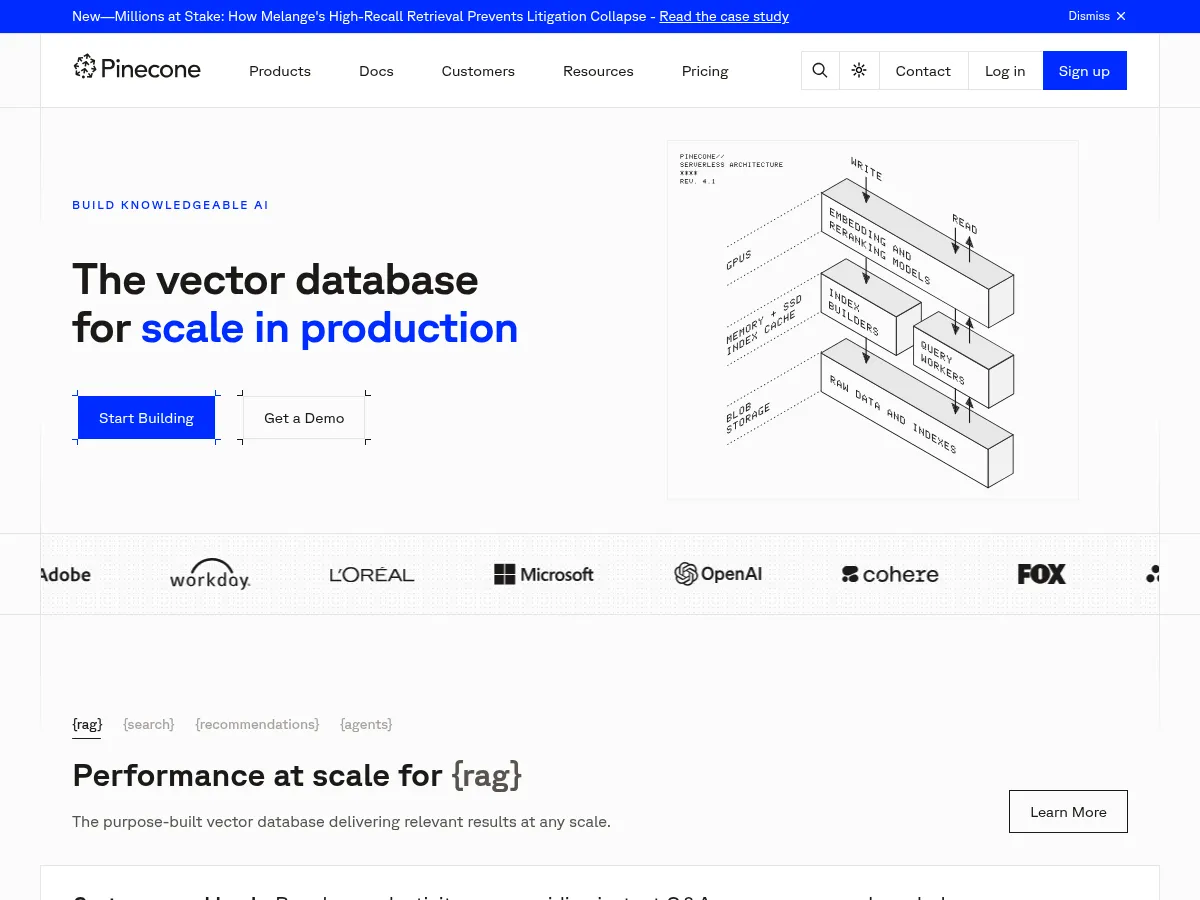
Pinecone is a managed vector database designed specifically for AI applications that require high-performance similarity search at scale. Founded in 2019 by Edo Liberty, a former director of Amazon AI Labs, Pinecone provides a cloud-native infrastructure for storing, indexing, and querying high-dimensional vector embeddings generated by machine learning models. Vector databases are essential components of modern AI systems, enabling capabilities like semantic search, recommendation engines, retrieval-augmented generation (RAG), anomaly detection, and deduplication by finding similar items based on the mathematical representations of their content rather than exact keyword matches. Pinecone differentiates itself through its fully managed approach, handling the complexities of vector indexing algorithms, distributed infrastructure, replication, and scaling automatically. Users simply upload their vectors and query them through a straightforward API, without needing to manage servers, tune index parameters, or handle infrastructure maintenance. The platform supports namespaces for data organization, metadata filtering for combining vector similarity with traditional attribute-based filtering, and sparse-dense hybrid search for improved retrieval accuracy. Pinecone operates on a serverless architecture that scales automatically based on usage and stores data durably across availability zones. It offers client libraries for Python, Node.js, Java, and Go, along with integrations with popular AI frameworks including LangChain, LlamaIndex, and Haystack. The platform provides a free Starter tier with limited storage and queries, a Standard tier with pay-as-you-go pricing based on storage and compute consumption, and an Enterprise tier with dedicated infrastructure, higher limits, SSO, and premium support. Pinecone has become one of the most widely adopted vector databases in the AI industry.
تحليل البيانات بالذكاء الاصطناعي
يمكّن Pinecone تحليل البيانات المدعوم بـ AI من خلال البحث عن التشابه الدلالي، مما يسمح للمنظمات بالعثور على الأنماط واكتشاف الشذوذ وتحديد التكرارات واكتشاف العلاقات داخل مجموعات البيانات الكبيرة بناءً على التمثيلات المتجهة بدلاً من المطابقات الدقيقة، مما يدعم سير عمل تحليلي متقدم.
أدوات RAG بالذكاء الاصطناعي
يعتبر Pinecone مكوناً أساسياً في أنابيب الجيل المعزز بالاسترجاع، حيث يخزن تضمينات المستندات ويتيح الاسترجاع الدلالي السريع للسياق ذي الصلة لاستعلامات LLM. تجعل تكاملاته مع LangChain و LlamaIndex وأطر عمل RAG الأخرى خياراً قياسياً لبناء تطبيقات AI المستندة إلى المعرفة.
قواعد بيانات المتجهات بالذكاء الاصطناعي
يعتبر Pinecone أحد قواعد البيانات المتجهة المدارة الأكثر اعتماداً على نطاق واسع، والمصممة خصيصاً لتخزين والاستعلام عن التضمينات عالية الأبعاد على نطاق واسع. يوفر بحث التشابه منخفض الكمون مع تصفية البيانات الوصفية والتوسع بدون خادم و API بسيط، ويعمل كعمود فقري لتخزين المتجهات لآلاف تطبيقات AI.
تفاصيل الأداة مجاني مع خيارات مدفوعة
التسعيرFreemium (Free Starter / Pay-as-you-go Standard / Custom Enterprise)
المنصةAPI, SaaS
المقر الرئيسيSan Francisco, CA
التأسيس2019
الخطة المجانيةنعم
API متاحنعم
خطة المؤسساتنعم
4.5
2 reviews
Processing Speed
4.7
Ease of Use
4.7
Accuracy and Reliability
4.5
Integration Flexibility
4.5
Insight Depth
2.5
Data Visualization
2
Claude Opus 4.6
AI Review
4.4/5
Pinecone is a leading fully managed vector database purpose-built for AI applications, particularly excelling in similarity search and retrieval-augmented generation (RAG) workflows. Its serverless architecture eliminates infrastructure management, letting developers focus on building rather than ops. The API is clean, well-documented, and supports multiple SDKs (Python, Node.js, Java, Go), making integration straightforward. Metadata filtering, namespaces, and sparse-dense hybrid search give it strong flexibility for production RAG pipelines. The free Starter tier is generous enough for prototyping, while pay-as-you-go pricing scales reasonably"though costs can climb with large-scale deployments compared to self-hosted alternatives like Milvus or Weaviate. As a pure vector database, its direct data analysis capabilities are limited; it's a retrieval layer rather than an analytics engine. Performance is consistently fast with low-latency queries even at scale. The managed nature and reliability make it an excellent choice for teams wanting a production-ready vector store without operational overhead, though power users seeking full control may prefer open-source options.