LangChain
حول
أطر عمل وكلاء الذكاء الاصطناعي
LangChain هي واحدة من أشهر الأطر العمل لبناء وكلاء مدعومة بالنماذج اللغوية الكبيرة. توفر أدوات لإنشاء وكلاء يمكنهم التفكير في الإجراءات التي يجب اتخاذها، واستخدام الأدوات والواجهات البرمجية الخارجية، والحفاظ على الذاكرة، والتعامل مع سير العمل متعدد الخطوات. يوسع LangGraph هذا بشكل أكبر من خلال معماريات وكلاء متعددة الجهات قائمة على الحالة والرسم البياني.
أدوات MLOps بالذكاء الاصطناعي
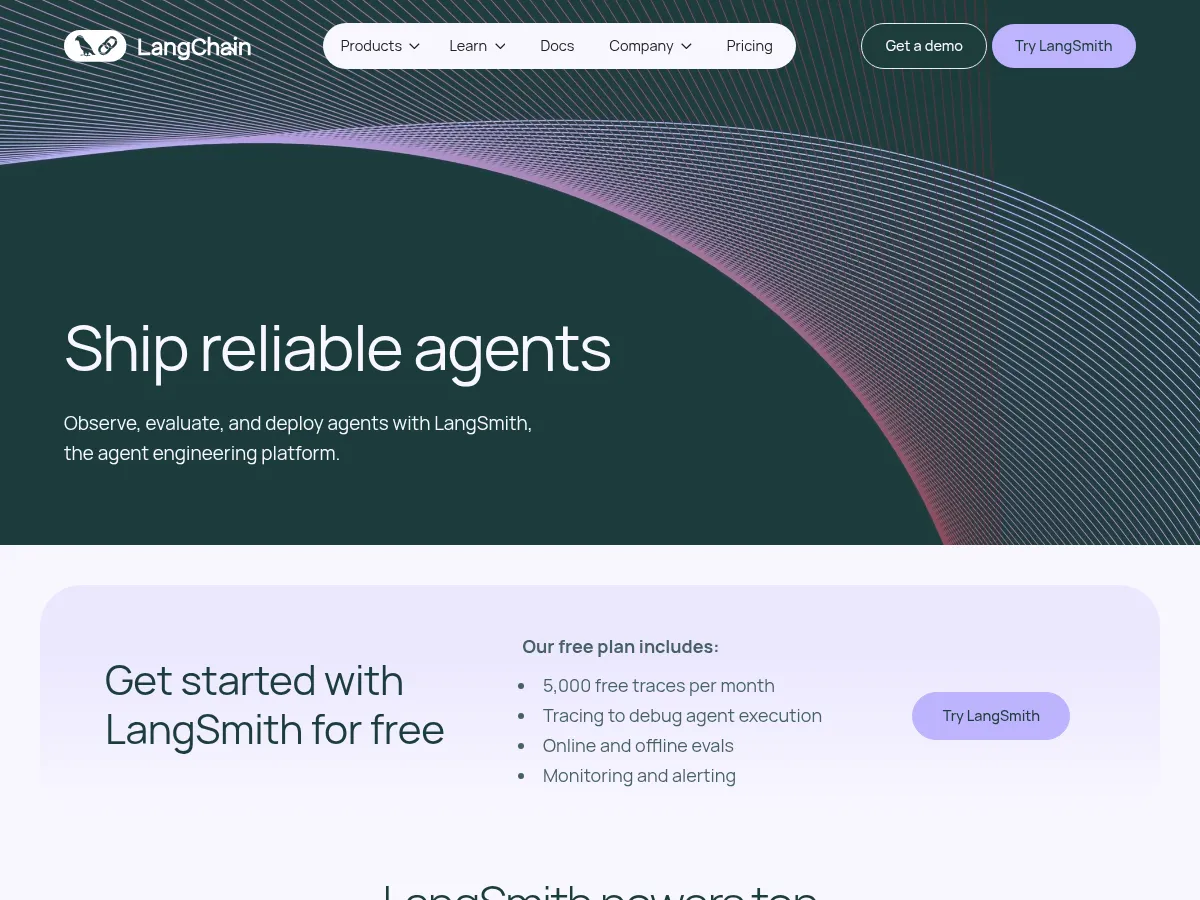
من خلال LangSmith، توفر نظام بيئة LangChain إمكانيات MLOps مصممة خصيصاً لتطبيقات النماذج اللغوية الكبيرة، بما في ذلك أدوات التتبع والتقييم والمراقبة وإدارة مجموعات البيانات والاختبار. تمكّن هذه الأدوات الفرق من تصحيح أخطاء وتحسين ومراقبة تطبيقات النماذج اللغوية الكبيرة في الإنتاج مع الحصول على رؤية شاملة.
هندسة المطالبات بالذكاء الاصطناعي
LangChain توفر أدوات إدارة موجزات منظمة تشمل قوالب الموجزات واختيارات الأمثلة القليلة ومحللي النتاج وأدوات تركيب الموجزات. تمكّن هذه الميزات المطورين من إنشاء واختبار وتحسين الموجزات بشكل منهجي بدلاً من إدارتها كسلاسل نصية خام.
أدوات RAG بالذكاء الاصطناعي
LangChain توفر كتل بناء شاملة لتوليد معزز بالاسترجاع، تشمل محملات المستندات لأكثر من 100 مصدر بيانات وفواصل النصوص وتكاملات التضمين وموصلات متاجر المتجهات وسلاسل الاسترجاع. وهي واحدة من أكثر أطر العمل استخداماً لبناء تطبيقات RAG التي تؤسس استجابات النماذج اللغوية الكبيرة في بيانات مخصصة.
واجهات برمجة نماذج اللغة الكبيرة
LangChain توفر واجهة موحدة للوصول إلى عشرات واجهات برمجة تطبيقات النماذج اللغوية الكبيرة من خلال تجريدات موحدة. يمكن للمطورين الانتقال بين OpenAI و Anthropic و Google و Mistral والنماذج المحلية وموفري آخرين بتغييرات كود بسيطة، مما يجعلها طبقة وسيطة متعددة الاستخدامات لاستهلاك واجهات برمجة تطبيقات النماذج اللغوية الكبيرة.
تفاصيل الأداة مجاني
LangChain has established itself as the de facto standard framework for building LLM-powered applications. Its modular architecture excels at chaining together prompts, tools, and memory into sophisticated agent workflows. The RAG capabilities are particularly impressive, with extensive document loaders, text splitters, and vector store integrations that make retrieval-augmented generation accessible out of the box.
The framework supports virtually every major LLM provider through a unified API abstraction, making it easy to swap models without rewriting application logic. Prompt templating and management are well-designed, though the learning curve can be steep given the rapidly evolving API surface"breaking changes between versions remain a common frustration.
LangSmith adds valuable MLOps capabilities for tracing, debugging, and evaluating chains in production, though the paid tiers ($39/seat/mo) add up for larger teams. The open-source core is genuinely free and community-driven, with excellent documentation and an active ecosystem.
Limitations include occasional over-abstraction that can obscure what's happening under the hood, and performance overhead compared to lighter alternatives like LlamaIndex for pure RAG use cases. Still, for comprehensive LLM application development, LangChain remains the most versatile choice available.
LangChain has rapidly evolved into the industry-standard framework for developing LLM-powered applications. It excels at abstracting the complexity of connecting language models with external data sources, making it a top-tier choice for building robust RAG pipelines and stateful AI agents, particularly with the introduction of LangGraph. The sheer volume of integrations"spanning virtually every vector database and model provider"is unmatched in the ecosystem.
For MLOps, the associated LangSmith platform offers critical observability, allowing developers to trace, debug, and evaluate complex chains effectively. However, this power comes with a steep learning curve. The framework can feel over-engineered for simple tasks, and its aggressive update cycle sometimes leads to fragmented documentation or breaking changes. While it abstracts prompt engineering and API interactions efficiently, developers seeking lightweight solutions might find the heavy abstraction layers burdensome. Nevertheless, for scalable, production-ready AI orchestration, LangChain remains the toolkit to beat.
 Powered by Rexiew