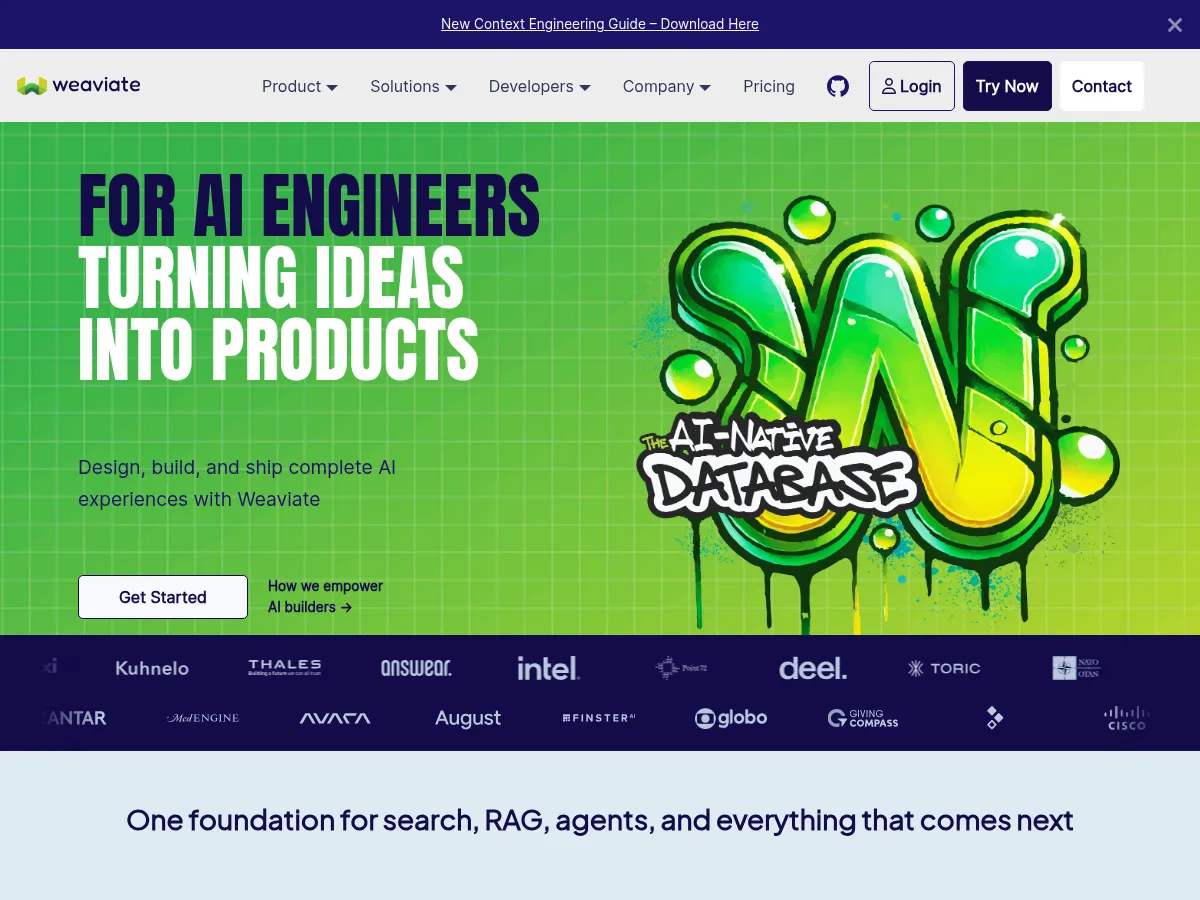
Weaviate is an open-source vector database designed for building AI-powered applications that require semantic search, retrieval-augmented generation, and hybrid search capabilities. Founded in 2019 in Amsterdam, Weaviate stores data objects alongside their vector embeddings and supports fast similarity search at scale using approximate nearest neighbor (ANN) algorithms. Unlike pure vector stores, Weaviate is a full-featured database that supports structured filtering, CRUD operations, multi-tenancy, and ACID transactions alongside vector search, making it suitable for production applications that need both semantic understanding and traditional data management. A distinguishing feature of Weaviate is its built-in vectorization modules that can automatically generate embeddings using integrated models from OpenAI, Cohere, Hugging Face, Google, and others, eliminating the need for developers to manage a separate embedding pipeline. Weaviate also supports hybrid search that combines vector similarity with keyword-based BM25 scoring, improving retrieval accuracy for many use cases. The database offers a GraphQL API and REST API for querying and data management, along with client libraries for Python, JavaScript, Go, and Java. Weaviate supports generative search modules that pipe retrieval results directly into LLMs for augmented generation, making it a comprehensive solution for RAG applications. It can be deployed self-hosted using Docker or Kubernetes, or through Weaviate Cloud Services (WCS), the managed cloud offering. Weaviate Cloud offers a free sandbox tier for experimentation, a Serverless tier with pay-as-you-go pricing based on stored objects, and an Enterprise tier with dedicated resources and premium support. The open-source version under the BSD-3-Clause license can be self-hosted at no cost. Weaviate is used by companies and developers building search engines, recommendation systems, chatbots, and knowledge management applications.
تحليل البيانات بالذكاء الاصطناعي
يمكّن Weaviate تحليل البيانات الدلالي من خلال السماح للمستخدمين بالبحث واستكشاف البيانات بناءً على المعنى بدلاً من المطابقات الدقيقة. توفر البحث الهجين والتصفية المنظمة وواجهة برمجية GraphQL أدوات قوية لاكتشاف الأنماط والعلاقات والرؤى ضمن مجموعات البيانات الكبيرة من خلال الاستعلامات المدعومة بالذكاء الاصطناعي.
أدوات RAG بالذكاء الاصطناعي
توفر Weaviate وحدات بحث توليدية مدمجة تجمع بين استرجاع المتجهات وتوليد نماذج اللغة الكبيرة، مما يخلق حلاً شاملاً لـ RAG داخل قاعدة البيانات نفسها. يجعل البحث الهجين والتوجيه التلقائي وتكامل نماذج اللغة الكبيرة منها منصة شاملة لبناء تطبيقات الإنشاء المدعوم بالاسترجاع.
قواعد بيانات المتجهات بالذكاء الاصطناعي
Weaviate هي قاعدة بيانات متجهة مفتوحة المصدر رائدة تخزن كائنات البيانات جنباً إلى جنب مع تضمينات متجهة الخاصة بها للبحث السريع عن التشابه. وهي تدعم البحث الهجين الذي يجمع بين استرجاع قائم على المتجهات والكلمات الرئيسية، وعلى عاملية التوجيه المدمجة، والعزل متعدد الاستئجار، ومعاملات ACID، مما يجعلها قاعدة بيانات كاملة الميزات لتطبيقات الذكاء الاصطناعي.
تفاصيل الأداة مجاني مع خيارات مدفوعة
التسعيرFree open-source self-hosted (Cloud: Freemium with pay-as-you-go Serverless)
المنصةAPI, Self-hosted
المقر الرئيسيAmsterdam, Netherlands
التأسيس2019
الخطة المجانيةنعم
API متاحنعم
مفتوح المصدرنعم
خطة المؤسساتنعم
4.6
2 reviews
Integration Flexibility
5
Accuracy and Reliability
4.5
Ease of Use
4
Processing Speed
3.5
Insight Depth
3.5
Data Visualization
2.5
Claude Opus 4.6
AI Review
4.5/5
Weaviate is a standout open-source vector database that has quickly become one of the top choices for AI-native search and retrieval-augmented generation (RAG) workflows. Its built-in vectorization modules eliminate the need to manage embedding pipelines separately, and hybrid search combining vector and keyword approaches works impressively well out of the box. The GraphQL-based API is intuitive, and multi-tenancy support makes it production-ready for SaaS applications.
The freemium cloud offering with serverless options lowers the barrier to entry, while self-hosting gives full control for teams with specific infrastructure requirements. Integration with LangChain, LlamaIndex, and major LLM providers makes RAG implementation straightforward.
On the limitations side, Weaviate can be resource-intensive at scale compared to lighter alternatives like Qdrant, and the learning curve for advanced schema configurations is notable. Its data analysis capabilities are more focused on similarity search than traditional analytics, so it's best paired with dedicated analysis tools for broader use cases. Overall, an excellent choice for teams building semantic search and RAG applications.